I think The Searchers is absurdly overrated, for it is far from flawless. But it is still a great work of art that plumbs deep themes and stirs deep feelings.
Its high esteem owes to several reasons. Auteur Theory, mainly established in America by Andrew Sarris who regarded John Ford very highly. Ford has been a pantheon among auteurs. Also, John Ford and the Western are considered quintessentially American, and the Western genre defined Classic Hollywood. Though Ford made several fine Westerns, THE SEARCHERS gets extra-nods for its high energy and darker themes. It is at once a Classic Western and something of an Alt-Western more in line with those of Anthony Mann. Then, there's the French Influence. Jean-Luc Godard claims to have wept at the ending of THE SEARCHERS. Of course, the Auteur Theory(or Policy) originated in France, long an influential hub of cinephilia. Then, there was the Movie Brat influence. The American filmmakers who came of prominence in the 1970s got hooked on THE SEARCHERS. Why that one than other Ford Westerns? It was old-fashioned and revisionist. As such, it had double or triple meanings open to post-modern interpretation. It was as if Ford was channeling something of Sam Fuller & Elia Kazan in slight but significant deviation from his formula, much like Alfred Hitchcock with his batch of movies such as REAR WINDOW and VERTIGO. THE SEARCHERS offered the nostalgia of Old Hollywood but also a bit of edginess to keep it relevant in the turmoil of the 60s and 70s. THE SEARCHERS, like VERTIGO, has been prized as a bridge between the old and the new, and also an indication of what Ford(and Hitchcock) might have been capable of with greater artistic freedom, available to later filmmakers like Sam Peckinpah and Robert Altman. THE SEARCHERS and VERTIGO represent the dawn of something new in American Cinema and yet also represent what was lost with the new freedoms(that could just as easily lead to indulgence as inspiration). If Scorsese wandered into the darker regions of Fordom, Spielberg remained in the lighter spaces, as in THE WAR HORSE. So, when film critics, film scholars, and filmmakers vote for THE SEARCHERS, they aren't necessarily saying it is really one of the top ten greatest movies. Rather, they are voting for what it represents in terms of genre, theme, and significance. It also explains why RASHOMON rates so highly in polls. Though Akira Kurosawa made several greater films, its cultural significance cannot be overstated. Its effect was electric at the time and introduced the world to Japanese cinema.
Although The Searchers is set in Texas in 1868, Ford’s treatment goes beyond the historical to the mythic and epic.
The Western genre is innately mythic, but THE SEARCHERS isn't really big on myth. It's more folkloric and picaresque. Ford generally wasn't interested in Western genre conventions of the classic gunfighter and the final showdown that served as the basis of the myth. His Westerns were more about a group of men(and good deal of womenfolks) than about the Man. SHANE has mythic overtones. Pauline Kael derided the hero as Kid Galahad on horseback. And of course, Sergio Leone pushed the Western myth to the stratosphere with ONCE UPON A TIME IN THE WEST, which is really about giants than men. Also, THE SEARCHERS doesn't feel like an epic. It spans several years over large territory, but the treatment is usually intimate and episodic than grandiose and sprawling. Much of the movie is a like a road movie or buddy comedy with Ethan & Marty and furthermore takes place in interiors. The movies doesn't try to be Large in the style of THE BIG TRAIL or THE BIG COUNTRY, let alone THE GIANT, a modern Western. There's no air of Importance to the story-telling. The obvious use of studio sets in some scenes further undermines the sense of the epic. Also, Ethan's brooding quality reminds us that he is more an embodiment of personal rage than a symbol of Western Expansion and Progress. He is an outlier.
The silhouette of a woman appears in the doorway... It is like watching a specter, a shade, taking on an embodied form. It has the feel of a creation myth. But what is being created? The answer seems to be civilization...
Ford didn't think in such big terms. That was the folkish Irish in him. She represents family, at most community. That's what Ford really loved and felt at home in. Civilization is a big concept with highfalutin ideas and monumental architecture. Ford had no real feeling for that. Even his modern movies, like THE LAST HURRAH, are more about community and a culture. In this, Ford felt sort of Indian-ish. After all, the Anglos often characterized the Irish as brutish, tribal, kin-oriented, and backward. Irish were more about pride than principles. So, even as Ford romanticized the coming of community to the West, he sort of lamented the coming of Civilization that would do away with manly roles and womanly roles in a close-knit community.
A rider approaches across the desert. This is a lawless land, where every stranger is regarded with apprehension.
Yes and No. There are Indian hostiles about for sure, and you never know when they might form a war party. But homestead is also part of an intimate community. Because there aren't as yet many people in the area, it seems all the white folks know each other by name. They are awful neighborly and supportive of one another, unlike city folks who are mostly strangers unto one another. So, unless there's Indian smoke and war drums, a figure on the horizon would likely be a familiar face and be welcomed into the house for coffee or broth.
Ethan clearly aims to stop fighting and make a home there... But Ethan’s attempt to reenter society and enjoy the fruits of peace does not last a single day, for there’s trouble afoot.
Ethan still can't get over the fact that the South lost. He has some of that Jesse James rage. If the Civil War were still on, he'd be in the fight as warring comes naturally to him. But by the time he reaches the home of his brother, he's come to bitterly accept that the North won and there's no way of turning back history. But deep down inside, he's smoldering over the defeat. He will fight with the Yankees against the Indians, but his Southern folks have been defeated by the Yankees, much like the Indians are being beaten by the cowboys. Also, he sides with white folks against the Red Man, but he probably feels bitter that the Yankee North waged war to free the semi-savage ni**ers against white Southern folks. The Yankees wage race war against the Red Man but also waged war on Southern White Man to free the black man who, being stronger and donger, could whup the white man.
In one way, the Indians disrupt his chance for peace and stability. In another way, the crisis saves him from a life of slow dissolution as just another farmer or rancher(like Eastwood character in the beginning of UNFORGIVEN before he embarks on a quest). He has reason to be a man of action once again, and he truly feels at home on the move. It's like the guy in TO LIVE AND DIE IN L.A., while genuinely enraged over his partner's death, uses the opportunity to get his nihilist kicks. War is tragic, but peace is tragic for the man of action. It's like what Douglas MacArthur said about old soldiers just fading away. And the men in THE BEST YEARS OF OUR LIVES, while glad to be back home, feel so humdrum. In war, they were heroes. And the military guy in WORLD TRADE CENTER(by Oliver Stone), though saddened by the terrorist attack, also welcomes it as godsend. He can finally do what his kind is meant for: To fight and destroy.
Who is Ethan Edwards? He is a warrior and a wanderer in wild spaces: the space between warring civilizations and the space between civilization and savagery. He lives in the state of nature, not civil society.
Ethan is functional in both. Unlike Travis Bickle who is a bundle of neuroticism, Ethan is an all-around personality who fits equally well in civil society and war zone. He can be sociable and chummy as well as fearsome and aggressive. He's in his environment as a wandering 'cowboy', but people of the community feel comfortable when he's around. He gets along with everyone while simultaneously standing his ground. In other words, Ethan is very much a John Wayne character. He's sort of like Pat Buchanan. Pugnacious and always relishing a fight but also amiable and sociable with people of all stripes.
Once the Confederacy was defeated, he fought for the Emperor Maximilian for money. But war is a young man’s game. Ethan is getting too old for it.
Age isn't really a factor in the movie. Sure, Ethan isn't a strapping young man anymore, but he's still younger than some others in the community. And his reason for 'coming home' was the bitter acceptance of the lost Southern cause. He stopped fighting because the Southern defeat was total. It seems that, for a time, in Jesse-James fashion, he took part in revenge violence against Yankees and Carpetbagger types. But it became pointless as the South was lost. It was a bitter pill to swallow but swallow he did.
On two occasions, the Ranger Captain Clayton chooses to ignore Ethan’s possible crimes because they need his help. They sense that Ethan is like them: a guardian of peace and family life...
It's mainly because Ethan is a tough guardian of self. It won't be easy to force one's will on a man like Ethan. While he's useful as another white man against the Indians, there's just enough outlaw in him to intimidate even a proud and tough man like Captain Clayton. Clayton knows Ethan will not come peaceably if he tries to arrest him. And other men would also think twice about arresting him. Besides, as fellow Texans who share the bitterness of the Southern defeat, they sort of empathize with Ethan's vengeful feelings and actions against the Yankees. It's like even law-abiding Southerners who didn't take part in Jesse James' criminality looked the other way because "it was for Dixie and nothing else".
For instance, when a fight breaks out at a wedding at the Jorgenson home, Ethan shoos Mrs. Jorgenson inside because he doesn’t think a woman should see such things.
I think he was just clowning, a way for him to say, "You womenfolk pretend to be for home and hearth but love to see a good fight like anyone else." So, his action was sarcastic than moralistic. It's like when Laurie pleads with Ethan to stop the fight, he tells SHE started it, and soon enough she's reveling in the sight of two men whupping each other over her.
When Ethan finds the bodies of Martha and Lucy, both of whom were presumably raped, he spares others the sight. He has peered into the abyss so that others don’t have to.
That was more personal than anything else. He loved Martha and feels that Marty setting his eyes on her ravaged naked body would be more violation of her dignity. As for Lucy's body, he kept that secret so that young Jorgenson wouldn't lose his head. Just as he predicted, once Jorgenson hears what really happened, he burns with rage and rides off into an Indian camp and gets killed. In a way, Ethan despairs what happened but also understands Jorgenson died a manly death.
Ethan doesn't try to protect Marty from the horrors of the world. He was certainly about to kill Debbie right in Marty's presence. And when he shot the eyes out of the dead Indian, Marty was there as witness.
Mrs. Jorgenson says, “A Texican’s nothin’ but a human man out on a limb . . . This year and next and maybe for a hundred more. But I don’t think it’ll be forever. Someday this country will be a fine good place to be . . . Maybe it needs our bones in the ground before that time can come . . .”
She was a school teacher, you know.
Texas is a pagan land that demands human sacrifices before it becomes a decent place to live. This is why Ethan interrupts the Christian burial of his family to begin the search for the killers. Texas is not yet ready for such niceties. It needs more blood and bones, and Ethan is ready to lay down his own.
This is over-interpreting Ethan's motives. He's just impatient for action. He is not a high concept person who thinks in terms of history, meaning, and significance. He lives for what is his, whom he knows and cares for. The only larger loyalty he had was to the South and only because of the Civil War that divided the US into North vs South. Even if Ethan lived in a civilized setting without red savages, he would always be impatient and a bit impulsive, like the Burt Reynolds character in DELIVERANCE who is eager to reach the river. (Why? Because it's there.) Or the Stampers of SOMETIMES A GREAT NOTION. Ethan isn't acting for civilization or even for Texas. The school teacher may see her life as part of something bigger, but Ethan lives for himself. Even his rescue mission for Debbie is really about his feelings, his sense of revenge, his personal vendetta.
Ethan is a man in a hurry. The proximate reason for haste is that with each passing minute, the girls are closer to rape, torture, and death. The deeper cause is that he’s over the hill, so his time is short.
With Lucy, that's true. She is a young woman, therefore a sexual target for the Indians. But even as victim of rape and murder, she would still be a white woman who resisted and understood the horror of what had happened. But it's different with Debbie. She wouldn't be raped. She would be turned Indian. She would be accepted into the very fabric of Indian life, and her loyalties would be with the Indians. She wouldn't be sexually violated but sexually initiated into Indian life to produce braves whom she would love as her own sons. In some ways, this is worse. It's like turning Greek boys into Janissary who genuinely accepted Islam and fought for Allah against Christendom.
It's like a white race-ist being killed by terrible Negroes is less tragic than white kids being turned into 'woke' enemies of their own race, essentially tools of vile Jewish Supremacists and ghastly Negroes.
He is cold and ruthless, using Martin as bait to trap and kill the treacherous merchant Futterman.
Actually, cold-and-ruthless would have been less unnerving. What's truly unsettling about the scene is Ethan's casual camaraderie with Marty. He uses Marty as bait but treats him like a long-lost little brother. Of course, one could say Ethan was just playacting, but his fondness for Marty(by that time) seems as genuine as the ploy is calculating. Thus, Ethan has the odd combination of warmth and ruthlessness(which could be said of Ford himself, a real son of a bitch but not without a heart). And the crazy-funny thing is Ford did it with comic touch. It's almost as if Marty passed the test of manhood with Ethan, much like Paulie saying, "You broke your cherry" to Henry in GOODFELLAS. It's the warrior's code. Warriors are a band of brothers but also expendable. It's just the name of the game. Ford made a movie called THEY WERE EXPENDABLE. So, the more Marty comes to accept his expendability, the more he becomes valuable to Ethan who lives his life like it's expendable.
He is also increasingly savage... He even slaughters buffalo simply to starve the Indians.
Modern times make us wonder what is and isn't savage. During World War I, the entire German civilian population was targeted for starvation with naval blockades. In the 1990s, Madeleine Albright and Bill Clinton, both products of elite institutions, implemented ruthless sanctions on Iraq that killed countless lives of children. And the US uses food-and-medicine as weapons in its Jewish-Supremacist war on Syria. So, Ethan's 'savagery' was pure amateur stuff compared to what civilizations do. In a way, the dichotomy of civilization vs savagery misses the mark. American Indians were more 'war-like' because there were many competing tribes. But there was peace within the tribe. So, if Indians fought more, it wasn't because they were naturally more warlike or savage but because the sphere of peace was smaller for them. They belonged to a tribe surrounded by other tribes. Civilization has much wider sphere of peace but only because more peoples have been conquered and forced into the sphere. But when we ponder America's war-making on nations and entities that remain outside, independent of, or hostile to the Globalist Empire, it's utterly 'savage' and ruthless. Just ask the Syrians. Just ask the Russians and pro-Russian Ukrainians in the Donbass. Just ask the Palestinians hated by the Jewish supremacist masters of America. We speak of civilization conquering savagery in the American West, but civilization itself is an amalgam of conquered peoples. The Irish who collaborated under the Anglos to conquer the West had themselves been forced into Pax Anglo. Same with Negroes. 20% of cowboys were Negroes, and they too warred with Indians. They too had been forced into Pax Anglo. So, spread of civilization is often about the conquered conquering the 'savages' yet to be conquered.
Ethan’s search for Debbie quickly takes on the quality of an obsession.
She is kin, the child of his brother. Also, she's the child of Martha, the woman Ethan loved. He lost Martha to Aaron, his own brother, and he's not about to lose the child of Martha to the Indians. Because she was abducted when young, the real problem is she can be raised to love the Indians. With Lucy, the Indians had to force their lust on her. But with Debbie, she could put out to some brave out of love. That would be the greatest betrayal.
There’s a lot to dislike about Ethan Edwards, but he’s the only man who could have rescued Debbie.
But the rescue is purely accidental, and her survival owes more to Marty. Despite all those years of wandering and searching, Ethan failed to rescue Debbie. He came close to killing her at one point, but Marty stood in his way. The final raid on the Indian Camp wasn't about Debbie. The cavalry was going to attack anyway, and she just happened to be there. And she could have easily gotten killed if the cavalry charged in. After all, plenty of Indian women and children were mowed down by the US cavalry. This is why Marty asks to sneak into the camp prior to the charge. And it is he who kills Scar. It wasn't Ethan's plan, but by this time, he's gained enough respect for Marty, who'd grown into full manhood, to let him have his way.
The central hangup of most critical writing about The Searchers is that Ethan is a “racist,” even a “virulent” one.
There is a virulent quality about Ethan, but what is impassioned among whites is usually called 'rabid' and 'virulent' by Jews. Of course, when Jews exhibit similar passions, those are noble and inspiring. Anyway, calling Ethan a 'racist' in the context of THE SEARCHERS seems pointless. I mean, who isn't a 'racist' in that setting? The movie features a race war between whites and Indians. Every white person in THE SEARCHERS is for the eradication of Indian savages to make way for white communities. Even the North, which abolished slavery in the South, was totally committed to Westward Expansion and the 'genocide' of the Indians. Whether Mr. Futterman the merchant is Jewish or not, plenty of Jewish merchants sold rifles and ammo to cowboys to go kill Indians with. Perhaps, the difference is other whites just do it as a necessary evil whereas Ethan really feels the 'racism' as a kind of all-consuming obsession.
A racist, in the words of Jim Goad, means “a vicious loser who hates people with different continental ancestry . . . merely to compensate for being an inadequate psychopath and to avoid taking responsibility for his own problems.”
There are people like that. Some white supremacist types are indeed the biggest losers. They aren't smart or strong. Their 'racism' is a crutch. They inflate their own egos and put down others to feel better about themselves. But this is true of all groups. Black supremacists tend to exaggerate 'we wuz kangz' BS to compensate for their loserdom in many fields. Now, if 'racism' was meant in this way, it wouldn't be a problem. The real problem is 'racism' now applies to ANY expression of white desire for self-preservation. So, any European nation that doesn't want to be swamped by the Third World is 'far right' and 'white supremacist'. Of course, Jews push this invective, but then, they demand that whites, who must forsake their own blood-and-territorial inheritance, totally support Jewish right of identity, pride, nationhood, and even hegemony over others.
It used to be 'racist' meant a nasty hateful jerk who hated just to hate. Now, a 'racist' is any white person who won't totally grovel before Jews and Negroes. And even if they do grovel, they would still be charged of 'white fragility' or some nonsense. But the fact that so many whites fall for this goes to show they are idiots. It seems white greatness owed to great white elites leading the white masses. Most white people are only good for following like sheeple. Once white elites abandoned their roles as proudly race-ist white rulers/leaders, the white masses just turned to the new Jewish elites for answers, and it's been ever increasing levels of cuckery.
Ethan clearly isn’t a racist in this sense. First of all, he is not ignorant of the Comanches. He knows their language and their myths. He respects them as enemies. He clearly hates them. But he doesn’t hate them because they are merely “different” or because he is a “loser.” He hates them because of their treachery, violence, and cruelty. They butchered his family after raping the women, something they did to countless other white families.
Comanches are a fearsome bunch, but whites are invading Comanche territories. Comanches fight back like the Germanic barbarians did against the Romans. So, even though whites are understandably horrified by Comanche brutality, it's hardly surprising that Comanches would react this way to white encroachment on their ancestral hunting and burial grounds. The thing about Ethan is he's a natural tribalist(though always wandering off into the turfs of other tribes). He feels most comfortable with us-versus-them view of the world. He even feels this way about whites. He surely killed lots of whites in the Civil War and even after the war. As a Southerner, he resented the North telling his kind what they can and can't do. As a white man, he's at war with Indians. As the brother of Aaron, he takes the massacre personally. If the Comanches had spared Aaron and Martha's family and gone after the Jorgensons, Ethan's anger wouldn't have been sufficient to become a 'searcher'. With Ethan, the personal is political and vice versa. The fact that he even fought in Mexico goes to show his main loyalty isn't to country or principles. It's about what feels right to him at the moment.
Critics are also exercised over the fact that Ethan would rather kill Debbie than allow her to stay with the Indians. Surely this is an expression of irrational “racism” and “hate.” But is it?
This is understandable. After all, Marty himself is shocked that Ethan would even dream of such thing. And Ford as storyteller is with Marty though privy to Ethan's motives. It's a variation of 'better dead than red'. It's been a common theme for people to prefer death with dignity than defeat with humiliation. In STAGECOACH, a southern gentleman saves the last bullet for the white woman lest she be taken by the Indians. Indeed, this rule applied to men as well. Better to save the last bullet for yourself than be taken hostage by Indians who might torture you in the most horrible way. In MASADA, the Zealots choose to end their lives than surrender to the Romans. In DOWNFALL, the Goebbels' wife would rather kill her kids than have them grow up as 'slaves' in defeated Germany. Many Japanese committed suicide than accept defeat in the Pacific War. A woman in13TH WARRIOR instructs another to kill the children than have them be taken as captives by the invaders if the defenses were to fail. The black woman in Toni Morrison's BELOVED killed her child than have her grow up as a slave. If white men had abducted an Indian child and raised him to fight on the side of whites against Indians, the boy's Indian father or uncle might have wanted him killed. Better than than have a red man fight for whites and kill fellow Indians.
Still, Ethan's decision to kill Debbie is deeply disturbing because she is wholly innocent. She was taken as a child by the Indians and raised as one. Under the circumstances, she is what she is. To kill her seems over-the-top, more an expression and realization of Ethan's personal rage than anything to do with justice or purpose. (Ethan would want to kill her even if or especially if she found happiness with the Indians.) Debbie's 'betrayal' isn't something she chose. She was acculturated into another world that accepted her as one of its own. It's like what happens to the white kid in THE EMERALD FOREST by John Boorman. He becomes a genuine Noble Savage. Now, in THE SEARCHERS, it's revealed at the end that Debbie never fully gave herself to the Indians. She did grow fond of them and came to regard them as her people, but deep down inside, she still remained true to her real family, like the priest in THE SILENCE(Martin Scorsese) kept the flame alive deep in his heart under captivity in Japan.
The real question about Ethan's decision to kill Debbie is, "Was it more for her sake or his sake?" I think it was more about his feelings, and on that note, it is wrong. It was his rage more than her interests that drove him to such extreme resolve.
Ethan also knows that once Debbie reaches puberty she will be raped. Maybe she will be killed then. Maybe she will be made into a squaw. Ethan would rather die than suffer that fate. He wants to spare Debbie from it. This isn’t racism and hate. It is an act of love in a terrible situation.
No, the rape issue was with Lucy. The problem with Debbie is she will be wed to an Indian. This is worse than rape as far as Ethan is concerned. At least in rape, there is the act of resistance. It's like the scene in THE BIRTH OF A NATION and THE LAST OF THE MOHICANS(by Michael Mann) where white women kill themselves than be taken by the Negro or Indian. White male 'racists' may be outraged by black-on-white rape but they are truly enraged by white-on-black love, aka Jungle Fever. At least the white rape victim resisted the Negro. In contrast, there is white lust and desire for the Negro in jungle fever. A white woman happily surrenders herself to black men. So, as horrible as Lucy's death was, Debbie's acculturation into Indian life seems worse to Ethan. She won't be raped but may 'freely' give herself to some Indian brave she regards as her husband to serve and obey.
Ethan would rather die than suffer such fate? You mean Ethan would rather kill her than suffer the fate of knowing of her 'betrayal'.
Whatever it is, can't it be race-ist and hate and love and honor all rolled into one? Why think in binaries? Ethan hates what has become of Debbie, but that hate exists only because of his love for her. It's often the case that the person you come to hate the most was the one you loved the most. You feel most betrayed when the person you trusted the most turns out the wrong way. The notion that Ethan, in his fit of rage and on the cusp of killing Debbie, was acting out of love is a bit of a stretch. There is love buried somewhere in Ethan's heart but also unhinged rage and hatred. He's not acting rationally based on questions of ethics(in terrible situations) but burning with fury of the moment.
The problem men face with women is twofold. In SEVEN SAMURAI, a woman abducted by bandits feels great shame, and later, face to face with husband, she would rather throw herself into the fire than have him look at her fallen self. (That peasant's rage makes Ethan's seem pale by comparison.) In THE WILD BUNCH however, it's not the case. When Angel asks the village elder if his woman Teresa was molested and taken, the old man says, "No, the bitchass ho ran off with General Mapache who has more blings to give her." Later when Angel encounters Teresa at Mapache's compound, she laughs at him, and he grows so enraged that he kills her. Kurosawa idealized the woman-as-saint, whereas Peckinpah saw women as natural whores, true enough in STRAW DOGS.
Raped by Black Savage or Jungle Fever? Long ago, maybe sex between black male and white female had a good chance of involving rape. Today, most of them are products of jungle fever, and furthermore, it's promoted by Jews and endorsed even by Conservatives and Donald Trump, the friend of Kim Kardashian.
TAXI DRIVER and HARDCORE, both written by Paul Schrader, reveal that the girls ran off on their own and chose to be whores than 'chores' and 'bores' in small town setting. And so many small town girls go to Hollywood and prefer to work as skanks than be stuck in nowhere-ville with the prospect of settling down with Average Joe. Even in PATTI HEARST where a white woman was really kidnapped and raped, she becomes one of the radicals soon enough. Coen Brothers did a variation on this with the porn girl in THE BIG LEBOWSKI:
And it is this question that haunts Ethan. How much of Debbie's 'betrayal' was forced on her and how much of it was voluntary? Is she a mere victim or a willing accomplice with the Indians?
Martin Scorsese was deeply influenced by The Searchers.
True, but his yammering about Ethan-the-'racist' is so sickening in that series he did on the Western. Sometimes, an Irishman would do well to paint his house.
Ford makes Martin Pawley one-eighth Cherokee. He first appears riding a horse bareback, then neatly dismounts while it is still trotting. He’s also late to dinner. Later we see that he is highly emotional and impulsive, although he is still a teenager. When he is a little older, he does not fight “fair” in a fist-fight. All this suggests that he has a bit of Indian wildness in him.
His entrance comes later to accentuate his 'intrusion' into the family setting as preferred by Ethan. The very sight of him triggers Ethan's deep-seated hostility. Ethan's reaction is 'animal', like when a dog instinctively feels wary of another creature. It takes time for Ethan's memory(of having saved Marty) and the family's affection for Marty to ease him back into the family setting. His mind knows that Marty is 'part of the family', but his heart remains wary of him. He feels tolerance but not bond.
As for being emotional and impulsive, those are more Irishy traits than Indian ones, whose stereotype was stone-faced stolidity. It's like Scar speaks in monotones. We learn that Ethan rescued Marty as a baby, and this foreshadows Ethan's rescuing(or sparing) of Debbie at the end. Both 'rescues' have an air of ambivalence. The white-man-side of Ethan didn't particularly care to save a 'half-breed' child, but perhaps the Christian side made him do, though he shunted the kid off to another family than raise him on his own. Likewise, we don't know until the very end what Ethan will do when he gets his hands on Debbie. He doesn't know it either, also the case with revisionist NOAH of Darren Aronofsky's movie that combines the Noah story with that of Abram. In the end, this 'Noah' just couldn't do it. The difference between Marty and Debbie is Ethan's heart wasn't into saving baby Marty but his mind was — he knew it was the right thing to do even though he didn't really care — , whereas with Debbie, his mind is set on killing her but his heart isn't, which is revealed at the end.
When Ethan sees him, he blurts out that he could be mistaken for a half-breed. In truth, he cannot. Played by Jeffrey Hunter, Marty has strikingly handsome Caucasian features
Yeah, Marty is supposed to have distinguishable Indian features. Back then, it was the norm in Hollywood to cast white actors for non-white roles. So, we must go with what Ethan says than what we see.
When Laurie suggests that it might be better for Debbie to die than stay with the Comanches, it is obviously not because she has a horror of miscegenation. Instead, she has a horror of rape.
No, it's more due to her feelings about mixing with savages. She doesn't like the idea of Debbie having Indian babies and living as a squaw-woman. She's high-spirited and proud but not particularly sympathetic. She's a bit vain and selfish, at least to the extent allowed by frontier experience. When Marty rides off to find Debbie, she takes it as personal slight and grievance. She wants Marty's attention on her than on Debbie. In this, she is sort of like Ethan. Both act like the world revolves around their feelings.
The characters of Marty and Laurie bring us to the main faults of The Searchers. They are incredibly annoying: less characters than caricatures. Perhaps these characters could have been saved by good acting, but both Jeffrey Hunter and Vera Miles as Laurie are committed over-actors. Marty is annoyingly whiny and buffoonish, and Laurie tends to be shrill.
I like Marty, but the performance is problematic because the actor was too old for the role, especially in the early years of the search. He acts too boyish for a full-grown man. Also, he plays the most morally and socially/racially complex character in the movie, but Ford wasn't sure whether he wanted Marty to be a comic sidekick or the voice of conscience. Vera Miles on the other hand shines like an apple. Her performance isn't subtle or complicated but from the heart, but Laurie is a simple girl with strong passions and full of spunk. She's a girl blossoming into womanhood, and it is peak Miles. It's a hearty and heartbreaking performance. She is bound by duty and does her chores and more but also defiant and self-centered. Her life revolves around work, but she wants the world, or at least Marty, to revolve around her. She's responsibility and vanity in one tight bundle. Even when she wails at Marty for choosing the search for Debbie over her, she goes through the trouble of retrieving the horse and handing(or hurling) him the rifle.
There is a great deal of childish flirting and bickering. It is often painful. But the worst thing about it is that Ford left nothing to accident. He clearly wanted it exactly this way, which is a terrible lapse of taste.
The problem lies in taking Ford and THE SEARCHERS too seriously. Ford never aspired to be a pure artist, and his movies are essentially folkloric popular entertainments. Much of the appeal owes to the air of familiarity. When you watch a Ford movie, you expect the similar cast of characters. It's like the Irish returning to Ireland to bask in Irishness. Ford's movies feel like 'home', even when set in the Western wilderness. Ford created his universe of characters, and the appeal was to popular and even vulgar taste. Ford wasn't exactly about good taste or sophistication. An average Ford movie was perhaps more complex than the usual Hollywood fare but not by much. His movies weren't Shakespeare or Dostoevsky. And much of THE SEARCHERS has to seen as Family Entertainment. It had nostalgic appeal, especially in the 1950s when Teen Culture was on the rise with the birth of the Cool. There's nothing cool about Ford's movies. When Laurie receives a letter, her parents hardly have any concept of privacy and tell her to read it out loud. It's old-fashioned and homey. Though Ford could be somewhat complex, his movies have to be taken like Norman Rockwell paintings(than Rembrandts). Naturally, they are filled with archetypes and caricatures than three-dimensional characters. THE SEARCHERS is very much the usual Ford fare but something a bit more, as if entertainment has been miscegenated with art into something promising to be wondrous, or monstrous.
terrible possibility that Lucas also copied Luke’s annoying whining from Marty and the juvenile bickering between Luke, Leia, and Han from similar scenes in The Searchers.
That owes more to screwball comedies.
By the end of the film, (Marty) is man enough to defy Ethan then fight off Laurie’s would-be groom, a grinning, drawling buffoon about whom the less said the better.
That 'grinning, drawling buffoon' is wonderful. It's hilarious because he talks like a hee-haw tard but sings like an angel. But the single most memorable character is Old Mose who looks racially ambiguous and is wonderfully goofy. He looks both infantile and senile. Inspired personality and performance. One thing for sure, characters like Old Mose show that the movie was as much bawdy comedy for the unwashed masses as a dark tale of race and redemption for thinking folks.
What happened? Obviously, Ethan has had a change of heart. But it makes perfect sense. He wanted to kill Debbie when she wanted to stay with Scar. But Scar is now dead, his people will be killed or captured, and Debbie has run away from the Comanches. So she has had a change of heart too. Now Ethan can rescue her, so he does. But that was Plan A all along.
No, this is too neat and rational. His murderous feelings toward Debbie went deeper than the problem of her loyalty to the Comanches. She'd been defiled in his eyes and is beyond redemption. Sure, his rage has abated some since his attempt to kill her, but the rage is still there, as Marty noticed many times. (Marty says that whenever Ethan talks about Debbie, his face goes 'red rum, red rum'.) And when Marty sneaks into the Indian camp, it is as much to protect her from Ethan as to save her from Scar. Marty fears that the US cavalry raid might serve as perfect moral cover for Ethan to kill Debbie(as surely some women and children will get killed in the melee). Even to the very end, Marty tries to stop Ethan, and Ethan strikes Marty to the ground and rides off in pursuit of Debbie. It is only when he holds her in his arms that he knows for sure that he won't harm her. It's like John Wayne's character wasn't sure what he was really going to do with Montgomery Clift's character in RED RIVER, an emotional precursor to THE SEARCHERS. On the one hand, Wayne's character vowed to kill the 'traitor', but face to face with the young man, he refuses to shoot him and slugs him instead until he is slugged back... until they make up. This element of THE SEARCHERS has something of 'existentialism'(fashionable at the time). In the end, we cannot sum up Ethan's final decision with recourse to logic, ethics, philosophy. He was torn between killing her and sparing her, and he didn't know what he'd really do until the very end when she was in his arms. In a way, she saves him as much as he saves her. That sense of mystery is what adds power to that scene. It's like the closing line of Scorsese's RAGING BULL. "So, for the second time, [the Pharisees] summoned the man who had been blind and said: 'Speak the truth before God. We know this fellow is a sinner.' 'Whether or not he is a sinner, I do not know.' the man replied. 'All I know is this: once I was blind and now I can see.'
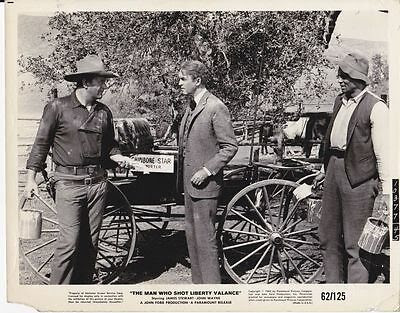
John Ford’s last great film The Man Who Shot Liberty Valance (1962) enjoys the status of a classic. I find it a deeply flawed, grating, and often ridiculous film... John Wayne and Jimmy Stewart, both fine actors given the impossible job of playing men in their 20s, even though they were aged 54 and 53 at the time. It just doesn’t work... The film is poorly paced as well, burning through screen time... Shinbone was built on a soundstage. Ford was known for shooting on location because he loved authenticity. But Shinbone’s cleanliness and newness—its clear artificiality—were quite deliberate representations of progress and the end of the frontier.
It's certainly an old man's movie. It was made at a time when the Western too had grown old and was on the way out, ironically not least due to its great success on the TV screen. When the Western became generic fare in every living room, it lost the silver screen luster, and in a way, THE MAN WHO SHOT LIBERTY VALANCE seems to be addressing the issue of TV and its impact on the Western. The use of sound-stage over actual locations suggest at this. Not only has the West been tamed but the Western itself has been tamed as weekly TV shows on all three networks. (Hitchcock likely also had the impact of TV on mind when he made PSYCHO, especially as he lent his name to a TV series.) Likewise, Sam Peckinpah's THE OSTERMAN WEEKEND is partly a commentary on the rise of home video and its impact on culture, not least cinema.
In a way, the West had a second life through the Western. Already by the time the first Western movie hit the screen, the Wild West was mostly thing of memory. The West had already become 'old'. But the Western genre made it 'young' again, and a very handsome John Wayne was there almost from the beginning, especially as the star of Raoul Walsh's magnificent THE BIG TRAIL. It was as if Manifest Destiny reborn, happening all over as American Saga in the form of the Western. The West was old but the Western was young, and in movies like STAGECOACH John Wayne conveyed that youthful spirit of the frontier. Indeed, John Wayne aged along with the Western. By the time he made THE MAN WHO SHOT LIBERTY VALANCE, he'd aged along with the genre that was soon on its last legs. And John Ford was even older.
So, LIBERTY VALANCE takes on different meanings depending on the context with which one watches the movie. Minus any context, one will notice many 'flaws' that may even seem ridiculous. Why didn't John Ford insist on using makeup to make Wayne and James Stewart look younger? Why do they look VISIBLY OLDER than the characters they're playing? And yet, this 'flaw' becomes a point and takes on meaning if seen as Ford's commentary on the Western and his place in it. As a story of recollection, it's taking place inside the soundstage of Ransom Stoddard's crusty old mind. It's sort of like a ghost-play. It's also as if Stoddard has forgotten how young they were and revisits those young days trapped in an old-man mentality. Thus, what seems slow-paced and even boring has to be seen as unfolding at an old-man's mental pace. It's a narrative with cobwebs. Stoddard has to rummage through the closets and attics of his mind to recall how things had been. Also, there's added tension because Stoddard's intention is to tell the truth and nothing but the truth, but personal memory is never a sure thing. The stage-like quality of the movie conveys this: the past has to be reconstructed to be deconstructed. Also, as the story is essentially subjective, drawn from Stoddard's memory, and shows the limitation of Stoddard's perspective. He's a man of words & ideas and never felt at home in the actual Wild West. He was too busy building order out of it, and the narrative and the setting are ordered and arranged like so many toy houses and train set. However, for a story that is largely subjective recollection, there are scenes without Stoddard. How could Stoddard know of them if he wasn't there? At best, he could have heard of what happened elsewhere or surmised with his own intuition(and limited imagination). Or, maybe John Ford just used the age-old convention where the flashback, though initiated as subjective memory, turns into a kind of omnipotent survey of the past. But then, LIBERTY VALANCE is less about actual facts of the West than about a certain myth. In the end, all the details of something, true or not, matter far less than the key issue of myth. And the element of myth was inseparable from the West and especially the Western. In a way, a Western trying to be real or truthful is a fool's game as its very essence is the myth. Pull on the loose thread of truth from the Western fabric and the whole thing comes apart. This was because the Western was constructed as a myth than as history, and John Ford played as big a role, maybe the biggest, as anyone else. Initially, in movies like THE BIG TRAIL, the Western had yet to be formulated into a genre or convention and could be lots of things. Indeed, CIMARRON, unjustly overlooked, features so many real-life aspects of the Old West. For the Western to live on as popular entertainment, it had to dispense with too-much-truth and too-many-details and be streamlined more into myth of movement and heroism. With STAGECOACH, John Ford contributed to the formulation of the Western into a tight genre, but he also remained true to the original vision of the Western as a sprawling and unruly genre with big cast of characters, which is why THE SEARCHERS is such a rich movie: it's about far more than Cowboys and Indians. Ford generally showed more of life and community than fixating on the 'lone hero'.
One of the central myths of the West was the good guy winning at the end, but of course, it wasn't so. Often the bad guys won, and the West grew out of corruption, compromise, and tyranny as much by morality, community, and civilization. The Western Myth says there was this Wilderness full of savage Indians and unruly outlaws who made it difficult for good decent hardworking folks. But then, some redemptive hero or upright sheriff came to town and cleaned things up, and the good triumphed over the bad. But in truth, those with power generally kept the power, got to appoint the lawmen, and cut deals with politicians. In the West, the big ranchers won over the 'sodbusters', especially as the land there wasn't much good for farming. This was suggested by HIGH NOON where the good folks in town want Will Kane(Gary Cooper) gone. Why have him stick around and fight for honor and pride when what the town needs is Good Publicity that will attract investment? Frank Miller may be a bad egg, even a rotten egg, but his ilk will always be around and may even loosen things up for business as profits are associated with vice. It's like Pottersville is a more 'happening' place than Bedford Falls in IT'S A WONDERFUL LIFE. So, the Western Myth is just that, a fiction for the most part. It was not the case of mostly good folks terrorized by a handful of wicked folks who were vanquished by the hero who then rode off while the good folks finally had their community. Rather, civilization came with the power, corruption, compromise, and violence. Indeed, it is the very forces of business and progress who hire the goons in MCCABE AND MRS. MILLER to be rid of the 'independent' businessman. (And today, Amazon, Facebook, Google, and Wall Street work with Deep State to crush the opposition, slander dissidents, and suppress critics.)
Many conservatives were offended by HIGH NOON though it later came to be loved by them. For classicists like Howard Hawks, it wasn't only an affront to the American Way but the Western genre. He hated the way the hero acted, filled with doubt and desperately hoping for support. And finally, he killed Frank Miller with the help of his wife who scratched the bad man's face. Ford may have agreed with Hawks in some respects, but he had his own doubts about the West and the Western, and it surfaced in THE SEARCHERS but especially with the later three: SERGEANT RUTLEDGE, CHEYENNE AUTUMN, and THE MAN WHO SHOT LIBERTY VALANCE. The Woody Strode movie SERGEANT RUTLEDGE is the most blatantly political one. An innocent upstanding Negro military man is charged with rape, and etc. It's a bit too stiff and preachy. Some see CHEYENNE AUTUMN as a kind of atonement on part of Ford who often featured Indians as shooting ducks but also formed a bond with Indian communities who respected him. It's a good movie but, like SERGEANT RUTLEDGE, marred by the heavy-messaging. Ford was good as a sentimental moralist but didn't fare well as a preacher or pontificator. Of the three movies, LIBERTY VALANCE works best because the message is slowly revealed and reflected on than just pushed in front of us.
It's been said it's impossible to teach an old dog new tricks, and this was true enough of John Ford(but not so with John Huston, but then, he was always young-and-lion at heart). John Ford understood this about himself and didn't try to keep with new trends. That said, he was aware of what was happening in world cinema, and his later movies, while resolutely and unmistakably Fordian, reflected on the changes. Thus, THE SEARCHERS is more complex than his earlier movies, and some might even say LIBERTY VALANCE borders on a kind of experimentalism, a kind of Ford's version of CITIZEN KANE and RASHOMON(or even LAST YEAR AT MARIENBAD). In style, one might say it's even stiffer, stodgier, and stuffier than Ford's earlier movies, but the very deliberateness suggests Ford's intentions were artistic than economic. It's more threaded than threadbare. Andrew Sarris rated it higher than LAWRENCE OF ARABIA(which he detested) and even JULES AND JIM(which he loved), but then, he was a Ford-nut. Also, just when many cineastes in America were favoring Foreign Cinema(as art) over the American(as tired entertainment), French critics(who would turn out to be very influential), argued that the Hollywood 'auteurs' were not only great entertainers and genuine artists but remarkably personal, experimental, and innovative in their own right, thereby relevant and inspirational to New Cinema. So, the man who shot THE MAN WHO SHOT LIBERTY VALANCE was far more than he let on. Though Ford to the end claimed he was nothing more than a maker of Western movies, part humility and part pride in the common-man, but the care put into works like MY DARLIING CLEMENTINE and THE SEARCHERS show he took film-making very seriously. He was a drunk but no slouch. At any rate, perspective shaped one's view of Ford. For those who didn't take him seriously as an artist but acknowledged his skills as entertainer, his earlier works were the best for their relative simplicity and straightforwardness. It's like Pauline Kael loved early Hitchcock and could tolerate an early Ford, but she had little use for later and more elaborate Hitchcock and even less for movies like THE SEARCHERS that some of her colleagues were beginning to take seriously. From the vantage point of Ford-as-entertainer, LIBERTY VALANCE is the work of a tired old crank. It seems stiff and stodgy. But from the vantage point of Ford-as-artist, the work seems stark and striking in its barrenness. It's like a musical artist going unplugged or picking up an acoustic guitar with minimum accompaniment after working with a band and electricity. Also, LIBERTY VALANCE, with its unmistakable studio-setting, which renders it more like theatre than cinema, reminds us of the artificiality of all cinema, whether shot in a warehouse or in actual locations. So, even as LIBERTY VALANCE seems less real and 'authentic', it could be said to be more honest in the make-believe-ness of the movies.
When Ford first used James Stewart in TWO RODE TOGETHER(which I haven't seen), he surely had in mind the latter's roles in Anthony Mann Westerns that significantly deviated from the 'classic style'. They were like Noir Westerns, far darker and twisted. And Stewart played it neurotic, bordering on unhinged over trifles. WINCHESTER 73 boils down the violence to childhood psychology, kids fighting over toy guns. Not just 'boys will be boys' but 'men will be boys'. Granted, Stewart already displayed amazing range in IT'S A WONDERFUL LIFE, surely one of the greatest movie performances, ranging from light comedy to the darkest tragedy. Mann and Hitchcock, especially in MAN FROM LARAMIE and VERTIGO, picked up this side of Stewart. (Stewart in THE MAN WHO KNEW TOO MUCH also played someone faced with the crisis of uttering the truth.) They used Stewart like the homo-preacher was going to use Joe Buck in THE MIDNIGHT COWBOY. There was an All-American straightness to Stewart but also an element of hysteria to the can-do boy-wonder exuberance. Mann picked up on this one-man Dr.-Jekyll-and-Mr.-Hyde quality about Stewart who plays straight-man to his own repressed craziness bursting forth.
In the Western Comedy DESTRY RIDES AGAIN, Stewart played a lawman who doesn't carry a gun, at least initially. By the time Mann got around to casting Stewart, things got a lot darker, and this may have owed to Mann making his mark in Film Noir before he moved onto Westerns. While actors like Marlon Brando profoundly changed movie to movie, the classic Hollywood stars carried their careers like a baggage. They weren't just playing the latest roles but representing the entirety of their screen persona. So, by the time Stewart signed onto Ford movies, he couldn't help but carry over the changes to his stardom in the 1950s, especially under Hitchcock and Mann, and this adds to the meaning of LIBERTY VALANCE.
From the beginning, the American West was rife with myth, not least because it was part wild and wild settled. It was settled enough for messages to get out by horse, train, and telegraph, but wild enough that tall-tales and legends could win out over facts and truth. It's like the opening of EXCALIBUR. Dark Ages give rise to legends and myths because stories, unverified, take on a life of their own, transformed as they go from person to person who embellish them with their own imagination, lapses, and biases. In a way, the Wild West was like the history of Western Civilization itself from barbarism to civilization in truncated form over less than a century. It had elements of the Dark Ages, Middle Ages, Renaissance, and Modernity. Some of the wildest, most savage, and most pristine land were transformed within two or three generations into the Modern World. In the established part of the world, the truth could be just as false. Indeed, at the end of LIBERTY VALANCE, it is the media elites of Shinbone, now a completed town, who reject the fact and keep with the legend. And it's hardly different today with the myth of MLK who was really a lout and punk as well as the spokesman of a great movement. And who can forget the myth of John F. Kennedy'? (Also, the JFK conspiracy theories, far from favoring facts over falsehood, have only added to the myth of 'Camelot'.) Still, if the powers-that-be determine the Narrative, whether mostly true or not, in the developed/established world, the power of narrative was far more democratic and unruly in the Wild West, a kind of worldwide-web-on-horseback, and so many tales and legends proliferated. In a way, the newspaper man in LIBERTY VALANCE is a courageous champion of freedom and truth, but he also represents the coming of the institutionalization of information, with all its problems as well as advantages. It's like the media conglomerates today make a lot of noise about misinformation and disinformation on the internet(which is an understandable concern) but use their great power and reach to spread their own 'fake news' and PC nonsense, like BLM and 'mostly peaceful riots'. And who can forget WMD. And the official story on 9/11 seems far from complete. Ideally, the powerful will defend truth against falsehood, but in truth, the powerful push whatever, factual or false, that favors its power. That being so, it's better that the masses have their own power to lie as well. Lies vs Lies is still better than Only-These-Lies.
In a way, LIBERTY VALANCE is a study in futility. After all, most Americans got used to the Western Myth. Most Americans knew that all those stories of Billy the Kid in books and movies weren't the real truth. Same went for Jesse James(though his story was more Southern than Western). Europe had its Dark Ages, and the Near East was a place of God and gods in the Ancient World, but America was founded on Christian probity, material ambition, and rational politics(based on the Enlightenment). Those had great advantages but lacked in the stuff of myth. Granted, even the rationalist underpinning of Americanism had its own lore and myth, like the fake story of young George Washington chopping the cherry tree but vowing not to lie to his father. But because America was founded on rationalism, it envied the Old World with its deep history where gods, dragons, fairies, and heroes once dwelled. And yet, the Wild West provided an opportunity for such tales to develop. While Western heroes weren't exactly knights with magic swords and Western villains weren't exactly dragons or monsters with horns, their stories happened in a world where most information spread as tall-tales or songs. So, given that the very appeal of the West and especially the Western was based on its mythic content, one may wonder why a work like LIBERTY VALANCE was necessary. It wasn't as if anyone took the Western as the real story of the West. And yet, it mattered to John Ford because he was perhaps the most important practitioner of the myth. Also, even if people consciously knew that the Western is myth than real history, it still exerted tremendous influence on Americans(and people around the world) in how they regarded America. In a way, all the more so precisely because myths are more appealing than mere history. It's like the appeal of so much of Black History is more myth than reality. In a way, Black America serves as something akin to the Last Frontier or the New Dark Ages where strange tales and mythic lore can rise because things are so crazy, murky, and chaotic in them parts. But even as blacks on the street are 'democratic' in their power to spin their own lies, it is the powerful Jewish-controlled media that select whichever of those lies are most useful to the Establishment. In 2020, it was evil 'racist' white cop killed saint George Floyd in TRUMP'S AMERICA. And the same is done with events in the Middle East and Ukraine, which seem as distant to Americans as the Wild West once did to Americans in the established Eastern cities. Just as those in NY media picked and chose the Wild West narratives that were useful to themselves, the current oligarchs of American Media pick and choose only those narratives in Syria and Ukraine that suit their agenda. "Assad gassed his own people." More things change, more they remain the same. So, what's been true of the Western Narrative has been true since the beginning of time and shall be to the end of time. After all, there are four Gospels, and they don't exactly agree on all the details. Also, even academics who obsess over 'texts' and 'subtexts' are less interested in the truth than on how the power used those 'texts' and how the current power should manipulate the 'text' to push a certain agenda. Today's academic put power above truth. Truth is everything and anything, and man lives with power, not truth. Power selects certain truths and mixes them with useful myths to create an alloy of authority. But then, what is higher than power itself? The gods, or what is considered holy and sacred. In the Current Year, the holies are Jews, Negroes, and Homos, and so, the big idea is that power must be summoned and solidified to serve those gods.
To those interested in 'textual' arguments, LIBERTY VALANCE is useful because it reduces everything and everyone into what is now called a 'trope'. It has all the elements of past John Ford westerns and even seems something like a 'highschool reunion' for the old gang(like in PEGGY SUE GOT MARRIED). But they're so much reviving their older screen personalities as wearing them as 'conventions'. It's like everyone is carrying a cardboard replica of themselves. It's John Wayne as 'John Wayne', and the same goes for the rest of the gang. It's old John Wayne playing young John Wayne, which is both poignant and awkward.
Consciously or not, Martin Scorsese, a great admirer of John Ford, made a couple of films that have something in common with LIBERTY VALANCE. The controversial THE LAST TEMPTATION OF CHRIST, or The Man Who Would Not Be Christ. In the fantasy sequence, 'Jesus' came down from the cross and chose the life of a normal Jewish man with wife and family. Later, he comes upon 'Paul' and accuses him of spreading lies. He, 'Jesus', didn't die on the cross. But 'Paul' says it doesn't matter what happened as long as the legend sticks as myth and fills so many lives with happiness. In other words, 'Jesus' doesn't need to die on the Cross for the myth of Christianity so spread and dominate the world. The myth is bigger than the man. And yet ultimately, 'Jesus' cannot accept this. No matter how successful and powerful Christianity may become and change people's lives, it would be based on a lie if he didn't die on the cross, and so, he returns to the cross and accepts his fate. A similar kind of logic underlies MEET JOHN DOE where a powerful social movement grows from a lie, that a certain John Doe chose to kill himself as protest against the inhumane world. The lie is exploited by the powerful as 'truth' but then 'exposed' as a lie when 'John Doe' turns against them. But then, 'John Doe' decides to really kill himself to give the movement a foundation in truth. The other Martin Scorsese film on Man vs Myth is THE IRISHMAN. Though almost certainly based on a lie(especially on how Jimmy Hoffa was killed), it examines the contrast between the world of appearances and of the world of shadows(or disappearances). In the end, the film is less about how-Hoffa-died than how a man squares himself to himself, his family, and finally God in terms of what he knew, what he felt, and what he did. Quentin Tarantino, a harsh critic of John Ford, did something opposite to LIBERTY VALANCE with ONCE UPON A TIME... IN HOLLYWOOD. If Ford was aiming for the truth hidden by the myth, Tarantino fantasized a myth over the ugly reality of what really happened to Roman Polanski's wife. Tarantino is his own Noodles, the camera is opium pipe, conjuring a fantasy of what-might-have-been. But then, he's a very pomo creature.
Watching THE IRISHMAN, it struck me how the film-making takes after John Ford’s ‘elements of style’, or the economy of poetics. Gone is the flashiness, the visual flourishes borrowed from Fellini, the house-of-mirrors of Welles. Scorsese was drawing on Ford’s way of paring it down to essentials and serving it straight. A tribute to Ford? Or, lesson mastered by pupil in late stage?
Ford thought that drunkards and men with funny voices were hilarious... There is also a great deal of scene-chewing overacting and overbroad parody that often seem downright cartoonish. Beyond these lapses of taste...
Ford was not a man of taste, and even though he could make relatively high-toned dramas like MARY OF SCOTLAND, he felt most at home with folkish tales of rough men in vulgar worlds. THE QUIET MAN certainly isn't a work of 'taste'. This is the meat-and-potatoes of Fordism. You got to take it all or not take it at all. The folkish style especially fell out with the rise of the Cool where most Americans became embarrassed to be associated with hee-haw and anything old-fashioned. This even affected Westerns. PAT GARRETT & BILLY THE KID has the first 'California Teeanger' in Beaver.
The Man Who Shot Liberty Valance also contains Left-liberal messages on race. For instance, Devine’s Marshal Link Appleyard is married to a Mexican woman... This must have been Ford’s preference... Wayne’s character Tom Doniphon has a loyal negro sidekick named Pompey (Woody Strode). Pompey even endures the indignity of being refused service at the saloon, but Doniphon stands up for him, although he does refer to him as “my boy Pompey.” ...Ransom Stoddard (Stewart) teaches reading and civics to a class of white adults, plus Pompey and a brood of Mexican children. (All the children in Shinbone are nonwhite, a poignant sign that white civilization has not yet been established there. Now such classrooms are signs of white civilization in decline.) Lawyer Stoddard teaches that the fundamental law of the land is the Declaration of Independence, which holds that “All men are created equal.” The Declaration, of course, is not the fundamental law of the land. That would be the Constitution, which says nothing about all men being created equal.
This is reverse-PC and ideological bean-counting. I would have an issue about mixed-race marriage in a movie is out-of-place, unlikely, and/or pushed as a message. But Shinbone is set in the Southwest. It could very well be a Texas town, and there were lots of white-Mexican marriages there. The legendary Billy the Kid had many Mexican girlfriends, and Pat Garrett was married to a Mexican woman. So, the fact that a white man has a Mexican wife in Shinbone hardly seems out of place or unlikely. Could there be a message in there somewhere? But it's hardly 'left-liberal'. The white man mating with non-white woman goes back to Pocahontas in American lore. Possibly the greatest American song, "Shenandoah", is about some white guy in love with the daughter of an Indian chief. In a way, these could be construed as love-conquers-all stories, like in ROMEO-AND-JULIET, but they could also be taken as white sexual imperialism. After all, sex has never been neutral between men and women. It's a matter of who does what to whom. As men are the dominant sex, the race with the men humping the women of another race has the upperhand. When whites ruled over blacks, most interracial offspring were white-male-and-black-female. Today, with black men dominating sports and rap music and kicking white butts in schools all across America, most mulattos are products of ACOWW or Afro-Colonization of White Wombs. When the Mongols invaded Russia and parts of Eastern Europe, it was yellow men sexually conquering white women. When white Americans militarily took over South Vietnam, it was a case of white(and black) men sexually colonizing me-so-horny yellow women. In a way, one could argue that even white-male-and-non-white-female pairing is 'anti-racist' in its 'interracism', but it was also used as a form of imperialism. This was especially true in South America or Latin America, traditionally far less 'liberal' than North America. There, Spanish men took many brown wives and created the mestizo race.
Doniphon-and-Pompey is a traditional relationship of that time. LIBERTY VALANCE takes place after slavery has been abolished, but if the South had won the Civil War, Doniphon could be Pompey's master. (Ironic that a former slave would be named 'Pompey' after the great Roman general. It either suggests Americans are ignorant of history or hints at black ascendancy in the future.) The thing is, apart from social distinctions, there is a personal bond between Doniphon and Pompey that go beyond the political. Doniphon is surely no racial egalitarian(and even Ransom is rather condescending to Pompey who is later given 'pork chop money'), but he's generally not a mean person(when he doesn't have to be) and much appreciates Pompey as his loyal sidekick, his Tonto. Of course, Pompey might be happier joining with Liberty Valance. Then, he could be a wildass ni**a, the mode of most blacks these days. I read somewhere that 20% of all cowboys were black, and most Westerns never took this into account. Among them, there must have been some crazy fellers so different from Pompey. Sergio Leone brought out the dark side of Woody Strode in ONCE UPON A TIME IN THE WEST. There, he is a menacing badass ni**a than a loyal servant.
A lot of children in Shinbone are Mexican because Southwest had a sizable Mexican population. Indeed, parts of the SW had already been settled by Mexicans and taken from Indians long before white folks arrived in numbers. Unlike the Great Plains and Northwest where white man took the land from savage Indians, the story of the Southwest was about white man taking the land from the semi-civilization already established by Mexicans, from whom Anglos also picked up lots of cowboy tricks.
While the Constitution isn't the same as the Declaration of Independence, the spirit of the latter is reflected in the letter of the former. After all, laws aren't just laws but guided by a spirit. If guided by monarchical spirit, laws reflect royal authority. But the US Constitution was guided by the spirit of the Declaration, and it's why the direction of American History and its Laws has been toward securing more rights and equal protections to all regardless of race, creed, and color.
Ford did not, however, identify with outsiders against America’s WASP ethnic core because he was Jewish. Instead, he did so as an Irish Catholic.
Chances are that, during most of John Ford's life, most WASPS were more 'progressive' on race than your average Irishman, Ford included. As a matter of idealism, Wasps were the main pushers of 'liberalism' on race. Jews pushed it for reasons that were more tribal than idealistic(though there was some of that too as many leftist Jews back then sincerely believed race was skin-deep). Many Irish were Democratic but more for ethnic and economic interests than high-minded idealism. Generally, Irish Catholics followed the Wasp lead on racial politics. While most Irish were opposed to stuff like the KKK(who bashed Catholics as well as Negroes), even the Irish Democratic Machine operators were a bunch of Archie Bunkers at heart.
Judging from Ford’s cavalry trilogy—Fort Apache (1948), She Wore the Yellow Ribbon (1949), and Rio Grande (1950)—the West could not have been won without the help of golden-hearted, silver-tongued Irish drunkards. These stereotypes seem rather broad and offensive today, but Ford—a heavy drinker himself—obviously regarded them affectionately and thought their inclusion to be progressive.
They wouldn't be offensive today because PC only cares about Jews, blacks, and homos. Mocking or making fun of whites or white groups is not only okay but obligatory. John Ford was profoundly Irish but in attitude and swagger than identity politics. He wasn't into Irish victimology or separatist thinking, but one can't help sensing the distinction between the Anglo way and the Celtic way in some of his works. It's buried somewhere in LIBERTY VALANCE as well. Ransom is very much an Anglo-kind of character. Very Waspy, whereas Doniphon is Irish-like. And the movie hints at the troubled but symbiotic relationship between the Anglo and the Irish. Anglos led with their big vision and ideas, and yet, no civilization is merely the work of ideas and principles, not even the US founded on liberty and rights. A lot of dirty work had to be done, and as the Irish and Catholics were generally poorer, cruder, and disadvantaged than the Anglos and Protestants, they ended up taking up a lot of the 'dirty' jobs involving muscle and sweat. Often, it was ham-fisted Irish cops who kept the blacks in line. In battles, the officers were more likely to be Anglo, whereas the Irish took the lower positions as footsoldiers. Granted, the Irish gained real fast in America, but the Anglo-Irish thing was like an ethnic version of the class-divide in England between the gentleman 'caste' and cockney-speaking laborers. In the film RAGTIME, the privileged family that takes in the Negro orphan is very Waspish, whereas the firemen who harass the Negro driver are visibly Irish, right down to the red noses from too much drink. In some ways, the rowdier side of the Irish could be seen as more honest and real, but it could also be seen as brutish and bigoted. The Irish developed a dual mindset in regard to Anglos. In a way, they were the first victims of British Imperialism, and their resistance later inspired other rebellions against the empire. And yet, the Irish were also like the pitbulls of the empire. They went wherever the Anglos went, terrorized the darkies, and did the 'dirty work' as overseers and enforcers. Thus, to those on the ground, the Irish seemed even more bigoted, tyrannical, and exploitative than the genteel Anglo who gave orders on horseback. Irish were at once the hammer of the empire and under its heel, and it's no wonder that today's Irish are both filled with victimology but also share in the 'white guilt'. (But then, blacks have been no different. They were oppressed under white rule but also benefitted from white victories and took part in neo-imperialist aggressions around the world. Blacks in today's military don't ask why they are ordered to bomb Syria or to threaten/invade other nations. They just do it, just like the Irish under Anglo orders long ago.)
The film’s message is deeply anti-liberal. Indeed, although Ford could not have known it, The Man Who Shot Liberty Valance illustrates many of Carl Schmitt’s criticisms of liberalism.
It depends on what you want to see. One could pick out the 'anti-conservative' elements of LIBERTY VALANCE and include it in 'left-wing cinema'. This is a fool's game. While some works are clearly 'liberal' while others are 'conservative', LIBERTY VALANCE can't be ideologically pigeonholed one way or another.
Played to cartoonish excess by Lee Marvin, Liberty Valance is a cold-blooded murderer and thief. He’s also a drunkard and a petty bully. The entire town of Shinbone lives in terror of him. He’s the kind of man who needs killing, so decent people can plant crops, raise children, and sleep at night.
Actually, Valance plays it both ways. He is a thief and killer but not at all times. He isn't merely a wolf or coyote but a weasel. When he robs a coach, he covers his mask. But in town, he act just lawful enough to pass as a member of the community. If he were a total outlaw(like the bandits in THE WILD BUNCH), he would be no use to the ranchers. In contrast, Valance wears many masks. He steals when he can, but at other times takes up regular jobs with the ranchers. In that sense, he's more like a proto-gangster, the creature of civilization, than a classic Western outlaw. Valance can easily adapt to the New Order. Indeed, the likes of Jimmy Hoffa operated as criminals as well as labor bosses. In the West, there were outlaws and then there were OUTLAWS. One bunch couldn't do anything but rob and steal. Another took up stealing as a hobby or side-job while doing other things as well. They had their feet on both sides of the fence, and Valance is quite an adaptive bastard. Thus, even as he intimidates the people of the town, his ilk can co-exist with change because the Power always needs muscle for hire. Today, the likes of him could work as a mercenary and blow things up in Syria.
It seems odd that an American movie would have a villain named Liberty. Isn’t America the land of liberty? But Liberty Valance is not really an American. He’s a man of the Wild West. America is a Republic with laws. The West is the state of nature. Liberty Valance represents the liberty of savages in the state of nature, where one man’s liberty is exercised at the expense of another’s.
It's also odd that the good guy's name is 'Ransom', usually associated with kidnapping and extortion. Anyway, I don't think Valance represents only the Wild West. His name 'Liberty' doesn't represent the state-of-nature or savage-freedom. Rather, it's ironic, a suggestion that American Liberty has always been compromised, corrupted, and hypocritical. Also, the name of 'Ransom' suggest that American Progress was brought about by holding all of us hostage to some faulty narrative.
For no sensible reason except that he likes her, Tom(John Wayne) awakens Hallie, who works as a waitress at a local eatery, to help tend to Stoddard’s wounds.
Doniphon doesn't see Ransom as a rival, understandably so as the latter is just barely alive after getting beaten up by Valance. He figures Hallie is ideal for taking care of Ransom as if he's a little child beaten up at school by bullies. He has more manly things to do than playing nurse. It's almost like finding an orphaned doe in the wild and handing it off to a woman to take care of.
Incidentally, there's a scene with a woman nursing a man in SERGEANT RUTLEDGE as well, and it might have been Ford's way of, wink-wink saying, THE NEGRO IS GONNA ROB US OF OUR MANHOOD. Unlike scrawny James Stewart, Woody Strode was a well-built guy, so there could have been sexual tension when the white woman tends to him though the times discouraged that stuff when it was made. On the one hand, Ford as an Irishman with bitter national memories, sympathized with Negroes who faced discrimination. But he was also mindful of racial differences. On the set, he often mocked John Wayne's manhood as movie-fake and pointed to Woody Strode as the Real Athlete of the bunch.
Rance doesn’t see any difference between force used by criminals and force used by decent men against criminals. He’s an idealist who apparently thinks the laws can magically enforce themselves.
No, Ransom isn't against guns or use of violence. He's against vigilantism. For the law to work, it has to be properly enforced by legal authority. And Ransom wants the people of the town to create and uphold a system that can ensure peace and stability by rightful use of force. But the state is weak in Shinbone. Its fatso sheriff is a nice guy but weak and a flunky. Doniphon is a good guy and perhaps has the ability and popular appeal to rally the citizens of the town to together to sustain proper law-and-order, but he's too much of an individualist and maverick(in his own right) to do what's good for the whole community. He's usually out for himself and into everyman-for-himself, something he favors precisely because he has the natural talent to take care of himself. He knows Valance is bad, but as long as Valance doesn't mess with him, he doesn't mess with Valance. He lacks a sense of the common good. He's a proto-libertarian and has something in common with Valance, the difference being Valance is nasty whereas Doniphon isn't. Doniphon has a good nature but doesn't stick his neck out any more than he has to. He believes it's up to every man to protect his own life and plot of land. The problem is that not everyone is made of the same stuff. Doniphon is big, strong, good with the gun, and has natural courage. He could take care of himself, but he's an exception than the rule. Most men, even though they own guns, dare not stand up to Valance. Valance feels he can rough up just about anyone, and Doniphon feels he has no obligation to protect anyone but himself and those closest to him. Such cannot be the basis of social order. In contrast, Ransom knows that justice-for-all can only be ensured by the enforcement of the law by the state. He's for the law-for-everyone than everyman-for-himself, which is essentially Doniphon's position. Indeed, the argument over the steak between Doniphon and Valance is less a matter of general principles — "it is wrong for Valance to act that way anywhere and with anyone" — than a matter of personal pride. Doniphon is enraged because Valance messed with HIS steak. If Valance had messed with another man's steak, Doniphon might just as well have looked the other way(and even despised the weakling who couldn't fight for his own steak).
(Ransom) is spindly, priggish, progressive zealot. He reminds me of Barack Obama.
No, Obama is no zealot, no real progressive. He's a smooth version of Valance, a globo-gangster and weasel with many masks. He could play race-hustler, cultural-marxist, cosmo-elite, genteel buppie, machine crook, warmonger(for the Jews), Wall Street shill, deep state flunky, and etc. Whatever faults Ransom has, he is a true man of principles. Also, he's very courageous, in some ways more than Doniphon, who is naturally big and strong and grew up doing all the Western things. In contrast, Ransom is an outsider who sticks his neck out even at the risk to his life and for total strangers. When the coach is robbed, most people just stand around passively and afraid. In contrast, Ransom rebukes Valance to his face. Foolish perhaps but it took real courage. Obama is just a gangster who looked around, noticed Jews got the power, and played their waterboy to be president.
Rance’s role in the community, however, is distinctly feminine. In a land where men wear guns and settle problems for themselves, he refuses to wear a gun and expects the law to settle disputes . . . somehow. Thus in the Ericsons’ restaurant, Rance wears an apron while washing dishes and occasionally waiting tables. (Obama also allowed himself to be photographed in an apron.) When Rance learns that Hallie can’t read, he takes on another stereotypically female role: schoolmarm.
Ransom not only expects the law to settle disputes but pushes for changes that finally bring that about. Thus, he's a visionary, and he's keen on practicing what he preaches, something rare these days. While it's true that Ransom partially comes to appreciate Doniphon and his ways, reverse is also true. Grudgingly, Doniphon acknowledges that Ransom has his own kind of toughness, courage, and resilience, a real tenacity. They sort of merge into one another, like Lawrence and Ali in LAWRENCE OF ARABIA, and Mendoza(Robert DeNiro) and Gabriel(Jeremy Irons) in THE MISSION. Mind envies the muscle, the muscle envies the mind.
Plenty of men in the West wore aprons. Sure, Western movies focus on the gunslingers, but most men did regular work to build the West. Butchers wore aprons. Grocers wore aprons. So many men wore aprons. It was not a woman's thing. It's like what Nixon's pa says in the movie:
Nixon's Ma - "Could thee at least remove that apron, Frank?"
Nixon's Pa - "This blood pays the bills, Hannah. I'm not ashamed of how I earn my money."
The problem of the Western Formula was it so over-emphasized the men-with-guns that it relegated to insignificance all the men who did the real work to make the West work. Naturally, we want to see men with guns than men with aprons & ladles, but the earlier Westerns did have a wider and more embracing vision of the West. The real West wasn't about men-with-guns and men-with-aprons but men-with-aprons-and-guns, and womenfolk learned how to use guns too, like the woman in RED RIVER. It's like the guys in GOODFELLAS both cook and kill. Paulie has a system of slicing garlic. And Clyde nearly got crushed by a man in an apron. In MIDNIGHT COWBOY, Joe Buck is someone who works with an apron but goes off to New York to play cowboy stud, a gunslinger with the ladies. He chases after the myth and runs from reality. In New York, he sees other men like himself working with aprons in restaurants. He is one of them, a regular Joe, but has been poisoned by the myth that dreams come true for the cowboy.
Of course, a Western could deviate too far from the men-with-guns narrative. There was a recent one called FIRST COW(which should be called FA**OTY MOO) that was 'gayish' or 'homo-social'(as its writer calls it) as shit. It was about two fellas, one Jewish and one Asian, in the Wild West stealing milk from a cow to... get this, bake muffins. It is the fa**otiest thing I ever did see, though I turned it off after 30 min. I didn't see BROKEBACK MOUNTIN', but even two cowpokes poking each other's bung is less 'gayish' than the idea of two guys out in the rough frontier having nothing better to do than bake muffins with stolen milk. Can anyone imagine Gary Cooper and Richard Widmark forming a team to milk a cow in the middle of the night to go bake cupcakes? It's the sort of tooty idea only a comfy city-slicker can cook up in his own world of creature comforts. "Gee, what if a sensitive Jewish guy met a naked Asian guy pursued by Russians(!!) and formed a 'homosocial' bond where they pick flowers and bake muffins together?" Total pukeville, but a favorite among critics, but they're a pansyass bunch who probably went off to get a muffin at Starbucks after the screening.
How is teaching someone how to read being a 'schoolmarm'? The hero of VIVA ZAPATA is ashamed he can't read. And the Viking leader in 13TH WARRIOR learns to scribble some lines from an Arab. Word is Power. Granted, teaching womenfolk(except for lesbians) to read beyond perusing personal letters(like Laurie in THE SEARCHERS) may not have been a good thing as most woman-minds aren't fit for real thinking and easily get confused. It's like what the girl says in KINGS OF SUMMER about her 'woman-brain'. Incidentally, if the tough guy loses the girl to the idea-guy in LIBERTY VALANCE, it's the opposite in KINGS OF SUMMER, more along the Arthurian Tale.
This too is an attitude more commonly associated with women. Ford clearly thinks that manliness is connected with a willingness to fight over matters of honor.
No. Often in Ford movies, women love the fact that men fight for stuff like land, honor, and pride... and especially over women. In THE SEARCHERS, Laurie, trying to be a Good Girl, beseeches others to stop the fight between Marty and the guitar-guy but soon loves the fact that two men are fighting over her. In THE QUIET MAN, the Irish beauty played by Maureen O'Hara doesn't mind that John Wayne's character wins her heart by knocking out other men. Boys will be boys, and girls will be girls(though, in our globo-homo age, boys will be girls, and girls will be boys).
Pro-Law stance of Ransom is essentially beta-male-ish as force is used by legal institutions to secure rights and protection for all men. Still, even though Ransom is physically beta-male, he has alpha-male ego when it comes to pushing others to follow his lead. Legalism can be advantageous or disadvantageous to whites. Clearly, laws based on equal protection eroded white power and privilege in the South vis-a-vis the Negro. But laws of equal protection, if properly applied, can be good for whites because individual fights for honor between blacks and whites will favor the blacks. If a Negro and a White fight over a steak, the chances are the black guy will win 9 times out of 10 or even 19 times out of 20. Honor as a personal code is a wonderful concept. For example, if you give your word, the honorable thing is to keep it. But in the Western setting, honor wasn't so much a matter of personal ethos as proving one's worth by guns or fist. But force doesn't favor the good over the bad. A good decent man can lose a gunfight to a total son of a bitch. Such 'honor' is really a matter of might-is-right, and naturally, Ransom has to oppose it. But would most white males want such an 'honor' culture living with blacks? Most times when white guys decide to fight Negroes for 'honor', they get beat up and lose their 'honor' of manhood, which is why it led to White Flight. Also, the reason for higher death rates in the black community is they fight over 'honor' of who done 'dissed' whom. They shoot each other over who stepped on whose gym-shoes. They are crazier than Wild Bill of Walter Hills movie where people are beaten or killed over 'hats'.
Rance furtively buys a gun and sneaks off to practice shooting. Why the deception? Because he can’t really reconcile it with his self-image and the image he has established with the public.
Ransom isn't opposed to guns per se. It's about who uses it and how. Ideally, he believes, lawmen with the backing of the community should have the power of guns to do away with the likes of Valance. But more importantly, he keeps his practicing with a gun secret because he doesn't want to lend the impression that he's a gunman and draw the wrong kind of attention from Valance and the like, especially as he has poor chance of winning any gunfight. He keeps a gun as a last resort. It's like, if a bully is messing with you, you might take up martial arts lessons and weight-lifting but secretly because it will take time for you to learn how to build up strength and learn how to fight. If you do it openly, it sends the message that you're cruisin' for a brusin'. (Indeed, weaker nations build up their military without fanfare. The last thing they want is attention.) Also, when Doniphon toys with Ransom by shooting cans and dousing him in paint, Ransom throws quite a punch and knocks Doniphon down hard. Ransom has quite a temper, just like when he stood up to Valance in their first encounter. One thing for sure, Ransom is the way he is out of commitment than cowardice.
There’s also a love triangle in the mix. Tom is in love with Hallie. Everybody sees it. But he hasn’t screwed up the courage to propose. It is his one failing of nerve as a man.
No, it's not due to a lack of nerve. Rather, he's so sure that Hallie will be his that he takes it for granted and goes about at his own chosen pace. It's like the hare that takes a nap in the race with the tortoise. He figures he will first build a nice place for them both and then ask her for marriage and then settle down. He's so sure of himself that he doesn't rush it with her.
Rance is pretty much zilch as a man, certainly nobody Tom would regard as a rival.
Dissident Right is full of brainy literary types who are more like Ransom than Doniphon, so I find it odd that Lynch would keep calling Ransom's manhood into question. Also, there are different kinds of power. There is brute power, but there is also the power of the mind and power of knowledge. In brute strength, Achilles and Ajax were far more manly than Odysseus, but Athena favored the latter for his intelligence. After all, what distinguishes man from beast is the mind. Most beasts are bigger and stronger than man, but man has dominion over horses and cows. Why? The power of the mind. In raw power, Uther was many times the man than his son Arthur, but Arthur is the one who creates the New Order based on righteous rule and theory of justice. With Uther, violence is the authority, i.e. whoever wins by might is right. With Arthur, might has to be backed by what's right. In Hallie's eyes, brutishness is a common feature of the world she inhabits. She's used to seeing problems settled by guns or fists alone. But then, Ransom comes along with a higher/better vision of society, and she is impressed by something so rare in that part of the world. She becomes aware of another kind of manhood, based on knowledge, power of words, and justice. Also, it's a matter of personality. Some women like muscle men, and some women like mental men. Hallie is illiterate but naturally quite bright and curious. Ransom makes a natural pair with her.
But Rance is no longer a child. He has faced death in a duel over honor.
But Ransom was never a child. And everything he did took a good deal of courage, even before the showdown. In a way, it was all the more courageous because he stuck by his figurative guns and kept true to his ideals/principles. It would have been easier for him to just throw up his hands, accept the world as it is, get some guns, and shoot bad guys. Rather, despite all the obstacles and disappointments, he chose to do it right by his principles and conscience. Of course, it too is a kind of personal pride as he doesn't want to admit he's wrong, sort of like Albert Brooks character of BROADCAST NEWS who does care about journalistic ethics but is also driven by ego and pride. What sets Ransom apart from most people in town? Most are resigned to rule by guns and tough guys. They keep their heads low. And tough guys like Valance and Doniphon also stick with the status quo as it favors them. In contrast, Ransom deviates from both norms, the passive one of most people and the violent one of tough guys. Like Cool Hand Luke, despite all the knocks, he won't give up and insists on doing it HIS way. And in the end, even Doniphon senses that Ransom's way is the better way and, furthermore, manly-in-its-own-right becauser Ransom struggles for the whole community whereas Doniphon's way was mostly for himself. Doniphon always lent a hand to the community but not his heart and soul.
When Tom sees them together, he knows that he has lost Hallie. He gets staggering drunk and burns his own house down in self-pity.
It's something far more than 'self-pity'. It is a genuine moment of personal tragedy.
...when he shot Liberty Valance, he became a man and a hero. It also launched his political career. But none of this sits well with Rance’s puritanical idealist streak. He feels that he bears the “mark of Cain” and is perhaps unworthy of public office.
No, he wasn't so much troubled by personal conscience over what he did. Rather, it's the Narrative pushed by the other side: Cold-blooded thug Ransom killed upright citizen Valance. The Narrative totally reverses the roles. So, he's perturbed by being painted as the very creature that he struggled against with his vision of law and order. Also, it's one thing to have killed Valance the scumbag, but it's quite another to build a political career on the killing, which reeks of opportunism, like so many politicians who used their war experience to win office as 'heroes'. But regardless of whether Doniphon or he really killed Valance, it can't be win-win for Ransom. If he did killed Valance, he's vulnerable to be clouded by the rival narrative that he's a cold-blooded murderer. If Doniphon did the killing, then his career is built on the deed of another man. Still, when Doniphon tells him the account of what-really-happened, he feels obligated to go in there and fight. He owes Doniphon one, and he felt this debt and burden all his life.
I wonder, though, if Tom’s story is even true. Did it really happen, or did he make it up to spare Rance’s feelings?
What might be true is both Ransom and Doniphon shot Valance at the same time. But surely Doniphon was there on the spot with the rifle because Hallie asked him to, and he couldn't say NO to her. And, why would Doniphon care about Ransom's feelings if he did not shoot Valance? He feels responsible for how Ransom feels precisely because he, Doniphon, was there and took action. Given that Doniphon lost Hallie to Ransom, protecting the latter's feelings would be the last thing on his mind if indeed he did NOT kill Valance. In a way, by telling of his role in the killing, he is owning the narrative between himself and Ransom. Indeed, it serves him more than it serves Ransom. Ransom often derided Doniphon as hardly better than Valance, a tough guy beast and thug, but Doniphon, with the tale, reveals that he is a beast with a heart of gold and even violated the Western code to protect Ransom, even if it meant risking losing Hallie to him. And it is that account by Doniphon that makes Ransom and Hallie feel forever indebted to him and even attend his funeral long after the whole town forgot who he is. Doniphon takes on the role of the 'unsung hero'.
Now, it’s possible Ransom and Doniphon both shot Liberty who was inebriated and didn’t take the gunfight seriously. But one thing for sure, whether Ransom’s bullet did or didn’t hit Valance, Doniphon’s certainly did, especially as he's handy with the rifle, a far more reliable weapon than the pistol in Ransom's shaky hand.
In a way, Ransom took on a suicide mission. He had about as much chance as the sodbuster against Jack Palance's hired killer in Shane. Indeed, Valance shoots him in the arm and mocks him. He toys with Ransom like a cat with a mouse. Why did Ransom decide to fight? It was a matter of rage and honor; every man has a breaking point. Valance just pushed too far, like Tybalt in ROMEO AND JULIET. He beat up the newspaper editor nearly to death. Valance brought out the dark side in him. He has to prove to himself and townsfolks that he can be pushed only so far, live or die. So, he goes after Valance not with any real expectation of killing him but to vent his rage. He most certainly didn’t expect to win. He just wanted to die with rage and honor. But miraculously, he killed the bugger or thinks he did. It’s as if Clarence the angel in IT’S A WONDERFUL LIFE was looking out for him. He is relieved by the good fortune, comparable in odds to Buster Douglas beating Mike Tyson.
Later, he becomes distraught over the affair mainly because of the SPIN used by political rivals. Ransom isn't overcome with guilt about having killed Valance. But he is tormented by the narrative that paints him as a cold-blooded murderer of Liberty Valance, a decent citizen. Now, that’s total BS, but the narrative takes on a life of its own. The real Valance was a killer, but the rival press pushes the story that Valance was a good guy killed by Ransom the murderer. The narrative flips reality and makes Ransom out to be the wild man who resorts to violence to settle matters. So, Ransom’s very words are turned against him, and precisely because of what he’d preached, it hurts to see it boomerang back to him(despite its lack of basis in fact). In the end, especially in politics, which is all about public perception, it isn’t so much what you are and what you did than what the public is made to believe. Ransom came to the West to create order out of chaos and rid the wilderness of killers, BUT he is made out to be the killer. That is too much for him. Being hyper-sensitive and a social person, he comes to be filled with self-doubt from the negative publicity spewed out by the other side.
Then, we can appreciate the significance of Doniphon spelling out the truth. At least on the personal level, this removes the burden of having killed Valance from Ransom’s shoulders. Also, Ransom realizes that he owes it to Doniphon to get back in the arena and fight. Doniphon did something he didn’t have to do. Also, even though the two men skip over it, Doniphon ended up sacrificing the girl because he saved Ransom. Indeed, Doniphon killed Valance as a favor to Hallie who was panic-stricken over Ransom. More than anything, Doniphon did it for her but didn’t know that she was really in love with Ransom. She meant more to him than anything in the world, and so, Ransom must go in there and keep fighting because Doniphon made the ultimate sacrifice.
Despite Valance’s intentions, his showdown with Stoddard officially counts as a duel, man-to-man. Thus, as both agreed to a shoot-out, it wouldn’t be murder no matter who died. But Doniphon wasn’t party to the duel, so what he did could be construed as ‘murder’. If two people agreed to a duel but YOU secretly shot one guy to help the other guy, your action would count as murder by law.
But seen in context of what we know, Doniphon’s act wasn’t murder. Valance was a wicked guy and Stoddard was no match for him. Their duel was like the one between Palance’s character and the sodbuster in SHANE.
There’s another factor. Doniphon takes pride in being a tough guy, facing a man straight on. That he killed a man from the shadows isn’t his style. He did something ‘dirty’ even if justified in saving Stoddard. It violated the Western code of standing on your own feet and facing the enemy, live or die. By the code of the West, Valance should have won even if he is the bad guy. In the West, being good and right isn’t good enough. You must back it up with guns. Doniphon intervened to make Stoddard the heroic slayer of Valance, but it was actually a subversion of the Western way.
Worse, it’s not as if Doniphon took Stoddard’s place, which is what happens in SHANE. Shane knows that Big Joe is no match for Palance the Cobra, and so, he acts as champion. Still, he has to duke it out with Big Joe because the latter would rather die like a man than have someone else fight for him. Joe’s pride is hurt, but Shane’s pride is intact because he faces the Cobra face to face. But Doniphon is denied even this pride of Western glory. He doesn’t take Stoddard’s place and goes face to face with Valance but shoots him from the dark. It’s almost like shooting someone in the back. He did something wrong(by the Code of the West) to do something right(for children and womenfolk), but it’s like the story of the dog looking into the water and losing its bone. Doniphon did it to make the West safe for womenfolk but lost his woman in the bargain.
Doniphon has been a tough guy all his life. Surely, he'd killed people(varmints) before he killed Valance. But he seems unperturbed by his past violence throughout the movie. He seems to sleep well at night without remorse for having used violence on bad guys or to get his way. What really destroys him is not the killing of Valance but losing Hallie to Ransom. He burns down the house he built for their future because he wants her to be happy, and her happiness is with Ransom. The price he pays for killing Valance is not remorse. He feels none. Nor does he face legal or social troubles over the death. Rather, it’s giving up Hallie to Ransom. Had he not intervened, Valance would have killed Ransom, and Hallie would have been his. But he saved Ransom, and he could see her heart was really with Ransom. Also, Hallie thinks Ransom really did kill Valance and feels both admiration for him as a Man and pity for him as the wounded underdog. She embraces not only a wounded 'child' but a 'hero', which makes her love him even more. And yet, the credit for killing Valance really belongs with Doniphon, and yet again, Doniphon doesn't want the credit because he killed Valance in a dastardly way by Western Code. Ransom 'stole' Doniphon's 'heroism' that wasn't actual heroism. Of course, Doniphon intervened without Ransom's plea for help, and so, it was less 'stolen valor' than 'bestowed valor'. However, Ransom doesn't appreciate the 'heroism' that really made his name in town. Doniphon feels all the more cheated. He allowed Ransom to own both the heroism and the girl, but Ransom grumbles about calling it quits over principles and feigned moral outrage from political opponents. Doniphon feels cheated by just about everyone. By the town that acknowledges Ransom as hero, by Hallie who's with Ransom, by himself who betrayed the Western code in the manner of Valance's killing, and by Ransom who doesn't appreciate the good fortune thanks to what Doniphon did. Doniphon is the one with the most to lose, but Ransom feels like he's the poor guy in the whole equation.
Valance is certainly vile, but his evil is petty; he doesn't represent the grander or deeper kind of evil. He's too beastly for contemplation which is at the base of True Evil, which emanates from knowledge, not ignorance. It's like Satan knows, indeed knows more than any entity except God, but he is evil incarnate at the profoundest level. Valance doesn’t represent anything resembling 'totalitarianism' but the very opposite: Anarchy, in which thuggery thrives. Ransom, though no 'totalitarian' himself, has more of a tendency toward authoritarianism. He is an idealist committed to liberty and justice but also a scold and control freak who thinks he knows best, especially in a frontier town deemed inferior to the established East. He disdains the rough freedom of the West. Ransom isn't a tyrant-wanna-be, but he’s the sort of guy who'd push a lot of regulations, some of them good, some of them sure to be a pain in the arse.
Anyway, the movie is more relevant than ever. Look at the Iraq War. Never mind there being no WMD. The mass media in cahoots with deep state said there was. And so, there was war. There was no Russia Collusion in 2016, but Jewish Media and Deep state said there was. It was the biggest attack on US since Pearl Harbor, said the Jews, and so many believed it. In 2020, some worthless trash George Floyd died of overdose, but the Media pushed the legend of saint Floyd, and his family got 25 million dollars and there are sacral murals all over. Never mind the reality. It’s the narrative, just like ‘hands up, don’t shoot’ nonsense from Ferguson. And the 2020 election. Lots of funny stuff, but just tell yourself, it’s all ‘baseless’ and just trust the ‘adults in the room’. Of course, many people know it's all a bunch of lies but believe go on believing them as 'noble lies', therefore justified. And LIBERTY VALANCE makes us think of US history and all of history as more legend than fact because people demand myths like hungry chicks screeching to be fed.
What is the true nature of power? It's probably like Angela Lansbury’s speech in THE MANCHURIAN CANDIDATE. Psychology of power is dark and perverse, and John Ford’s movie, which came out the same year, hints at it. In Ford’s movie, the only truly wicked character is Valance. And yet, even good people need lies to keep it together. Fairytales for adults.
Incidentally, both THE MANCHURIAN CANDIDATE and THE MAN WHO SHOT LIBERTY VALANCE proved to be prescient of the Kennedy Assassination and its controversie, not least theories about the Grassy Knoll.
(Ransom) no longer thinks his public esteem is based on killing, but shouldn’t he be bothered that it is based on a lie? Perhaps he can live with the lie by telling himself that he is doing good things for the people. But couldn’t he say the same thing about killing Liberty Valance?
Though not stated by Ransom and Hallie, I think the biggest sense of guilt on Ransom's part(as well as Hallie) is not about the killing or the matter of justice but that he took Hallie from Doniphon. That part is shown to us in the movie but surely not told to the newspapermen as Ransom tells the tale. (What we are shown is much more than what Ransom tells the newspaper man.) But what really complicated the three of them was Doniphon gave up Hallie. Seeing her in Ransom's arms, she still belonged to Doniphon if he'd asked for her hand. Not only did he court her for a long time but even saved Ransom due to her pleading. They both know this. But Doniphon knew that if Hallie married him, the bigger part of her would regret it and truly be in love with Ransom. He would rob her of true happiness. So, he let her go. He knows it, she knows it, and Ransom knows it. So, even though Ransom told the truth to the newspaper, he didn't tell the deeper truth, which was personal than political. The real issue involving Doniphon isn't "who shot Liberty Valance?" but "Who took Doniphon's girl?" Doniphon killed Liberty, but in a way, Ransom killed Doniphon who spent the rest of his life rather like Noodles in ONCE UPON A TIME IN AMERICA. Feeling sad, going to bed early.
The real tragedy in the movie isn’t about morality or remorse. It’s about the tragedy of love. (JULES AND JIM is also about the crisis of love among three.) The movie about the tragedy of political violence is LAWRENCE OF ARABIA where Arabia serves like a Western frontier for Lawrence, who is like half-Ransom and half-Doniphon(and a bit of Valance as well). He’s an intellectual and idealist… but also an insatiable man of action who comes to realize he loves violence.
In a way, the key figure in LIBERTY VALANCE is Hallie. She is torn between Doniphon, whom she expected to marry, and Ransom, whom she grows to love more. In the end, she chooses Ransom. She knows this is especially hurtful to Doniphon because he saved Ransom, only to lose her to him. It was a very difficult decision for her to make.
It’s like the decision in THE IRISHMAN, aka the Man Who Shot Jimmy Hoffa. Frank(Robert DeNiro) must choose between Hoffa and Russell. He loves Hoffa like a brother, a dear friend. Also, both are Irish. He respects Russell as a man of power and intelligence(and wisdom in that side of the world). In the end, he chooses the Italian over the fellow Irish. As to why, we can guess, but it’s one killing he could never shake off. He is the ‘Hallie’ in this equation.
The deeper truth that Rance evades is that, for civilization to come to the West, somebody needed to shoot Liberty Valance. It doesn’t really matter who.
Civilization would have come with or without Valance. Cities have always been full of crooks, thieves, and killers as any gangster movie makes clear. Valance is a bad guy but rather crafty and adaptive. Lyndon B. Johnson was equally a crook and politician; he may even have been a killer. What happened with Jeffrey Epstein is a clear indication that civilization is a gangster-operation at the top, and Japan and Italy have been known for fusion of organized crime and politics.
Also, it does matter who kills whom. After all, outlaws, thugs, and criminals are always killing one another. But when a thug kills a thug, the thug is once again triumphant. Had Valance been killed by another Valance, thug would be replaced by thug. So, it matters who does the killing and why. Doniphon is half-Ransom and half-Valance. Like Ransom, he's a good guy and sides with the good people in town. Like Valance, he relishes the wild anarchy of the West where a tough guy is king-of-the-hill, a natural nobleman. He doesn't use his might for evil, but he rather likes might-is-right as it favors his kind of skills. Doniphon is someone who could have thrown his lot with the Valances of the world, but he chooses Ransom, even though he could have had more fun and better relations as a partner of Valance who respects other tough guys. So, that Doniphon kills Valance is significant as it symbolizes the struggle in the heart of power between the good and evil. In killing Valance, he kills a part of himself. It's like the circular opening scene of PAT GARRETT & BILLY THE KID that suggests Garrett's killing of Billy the Kid was essentially killing himself. But if killing the outlaw is a good thing in LIBERTY VALANCE, it is a bad thing in PAT GARRETT.
The possibility that the story is false is supported Ford’s frank exploration of noble and ignoble lies later in the movie. Although the newspaper editor has pried the story out of Rance by insisting on his “right to the truth,” once the tale is told, he burns his notes and tells Rance he will not print the truth. “This is the West, Sir,” he says, “When the legend becomes fact, print the legend.”
This makes no sense. The motives of Doniphon in telling his account to Ransom and of Ransom in telling the truth to the newspaper editor are totally different in kind from the motive of the editor in burying the fact. Doniphon really wanted to get it off his chest, mainly because he lost Hallie to Ransom. It was his way of saying, "I saved your ass and lost my girl to you, so you better go in there and fight." He gave up the world as she meant everything to him. And Ransom tells the tale partly out of idealism and partly as tribute to Ransom. There is still that idealistic part of him that believes in truth and etc., and he sees in the newsman his younger self starting out in the West. But he also feels that Doniphon, so long forgotten that few even showed up at his funeral, should be credited as the unsung hero who really killed Valance and saved Ransom's life. Both Doniphon's and Ransom's motivations are in favor of truth. In contrast, the newsman's decision to edit out those facts is political or social. Why overturn a beautiful myth when so many people have come to believe in it? He figures the truth can do more harm than good. And yet, even his reasons are in sync with Doniphon and Ransom on some level. After all, there is a reason why Doniphon told no one but Ransom and why Ransom kept it a secret all these years. They all understood that it'd be better for themselves and the world if it was kept secret. Doniphon wanted it that way, and in a way, Ransom's revelation is both an act of tribute/reverence and betrayal. He told the story in honor of Doniphon, but Doniphon wanted to take the secret to his grave. And perhaps, the editor understood that as well, and it's no wonder Ransom doesn't object when the editor says, "When legend becomes fact, print the legend."
But why replace the truth with legend? What’s wrong with the truth? The superficial truth deals with who shot Liberty Valance: Tom or Rance? If Tom shot Liberty, he can’t be punished now because he’s dead. Rance, of course, kept the secret. Perhaps there would be legal consequences for that. But the real need for deception has to do with the deeper truth: somebody needed to shoot Liberty Valance so that civilization could come to the West,
But that doesn't make any sense. If what really mattered was that, in order for civilization to take root in the West, SOMEONE-ANYONE had to shoot Valance, then what does it matter if it's revealed that Doniphon did the killing? The editor would have been perfectly happy with the new fact as SOMEONE killed Valance. If the main issue is 'Valance had to go' and therefore, 'someone, just about anyone, had to kill him', then the story of 'Doniphon as killer' would be just as acceptable as 'Ransom as killer'. It'd be a case of "What does it matter if the cat is black or white as long as it catches the mice?" But in LIBERTY VALANCE, the story is rejected precisely because it is an issue of WHO. The official story has been about Ransom Stoddard, a man who bridged the East with the West with high ideals and vision. He wasn't only a man of books but soon became a man of the West. He stood up to a killer face to face and shot him dead and proved his mettle. And he built a career and served his community and nation well. He is a local hero, even a national figure. So many people have come to admire him and pay him respect. So, it would be a big deal to say that another man actually killed Valance and that the much admired Ransom built his career on a lie. It's like John McCain's career was built on his undying loyalty to America despite being tortured endlessly by the North Vietnamese. Actually, it was a big lie, and McCain and those around him knew the consequences of the lie being revealed. Granted, Ransom's lie wasn't ignoble like McCain's. Ransom really believed he'd killed Liberty, and when he found out otherwise, he knew Doniphon told him the tale to make him go into the political arena and fight. It's not like he stole the glory from Doniphon. Rather, Doniphon did him a favor and wanted him to follow upon it. Still, a lie is still a lie, especially in the public eye.
Liberalism seeks to do away with force and fraud in human relations.
No, liberalism seeks to concentrate force in the state governed by laws. Also, liberalism accepts that fraud is a part of life and ineradicable, and therefore there must be laws and procedures to deal with fraud and violations that will always be with us. Liberalism isn't utopianism, a vision of future where all people will be free, equal, and just. Liberalism is based on tolerance than perfectionism. Liberalism says we will never have perfection, and so, we must learn to tolerate the flaws and failings, but there is still a workable solution by systems of laws and enforcement to ameliorate the worst abuses of society.
Of course, 'liberalism' has many meanings. It could mean classical liberalism or libertarianism. It could mean the New Deal and Big-Governmentism. It could mean high taxes and social-democracy. It could mean the Welfare State and Great Society. It could mean the Nanny State where the state passes ever more rules and regulations(about guns and smoking) to make us do what's right. Or, nowadays, it could mean Neo-Liberalism where the globalists oligarchs, deep state elites, and ivory tower operatives all conspire to gain more control via monopolization, more wars, and hate propaganda against whomever they hate. Currently, what is called 'liberalism' is just Jewish Supremacist Gangsterism with globo-homo and magic-negro as gods.
Liberalism, in short, depends on illiberal men and extralegal violence for its very survival. But, instead of questioning their own ideological premises, liberals simply lie about this fact.
There is much truth in the above statement, but such hypocrisy isn't limited to liberalism. When barbarian lords became kings and fancy aristocrats, they begin to put on airs. Their power was based on violence and brutality, but the kings invoked some divine right. And aristocrats acted as if they were born of finer blood and that their authority was based on culture and sophistication than on exploitation of the masses who toiled in the fields. The Christian Churches pretended their authority was the blessing of God when it depended on an alliance with the military caste that rarely acted according to Christian ethos. Liberalism inherited than incubated such hypocrisy.
This is why we need fascism that is most honest in exploring and explaining how power really works, but fascism was disgraced by the Ridiculous Fascism of Mussolini and Ludicrous Fascism of Hitler who turned fascism into mindless personality cults.
Stewart wasn’t a manly man but he was certainly not effeminate, not to mention ‘gayish’, like Farley Granger. Also, we have to take Ransom's motivation into account. His rejection of the Wild West way is a matter of courage and principle, not cowardice and passivity. There’s a difference between refusing to pick up a gun out of fright and out of principle. Also, most men in town have guns but still cower before Valance. Guns alone are as useless as the Law alone. Guns need to be backed by skill, ability, courage, and resolve(and even a bit of reckless derring-do). People are anxious about resorting to violence not only in fear of bad guys but in fear of the state that might charge them of murder. In our time, patriots who use guns to defend their lives and property are often smeared and charged by the Jew-run system.
Ransom’s long-term vision is the right one. The only way to secure real peace is by everyone working together to create a stable system. That’s the only insurance against men like Valance. If the town relies on men like Doniphon to keep the likes of Valance at bay, it becomes a matter of whim and chance. It’d be like Greeks relying on temperamental Achilles in the war against the Trojans. Sometimes, Achilles feels like fighting, sometimes he does not, even if the Greeks are getting battered. Also, what if there is no one like Doniphon around? The good folks would be totally at the mercy of Valances of the world. So, for there to be real justice, there has to be a system of law enforced by the state, and that system can come about only with everyone playing his part instead of looking to the good tough guy to fend off the bad tough guy. (In SEVEN SAMURAI, the ronin not only defend the village but teach the farmers how to organize and fight.) Of course, until such a system is established, a man like Doniphon sure comes in handy but only as a temporary measure. For justice to be permanent, an impersonal system is essential.
So, Ransom is essentially right. He is wrong in his reluctance to resort to rough justice in the interim period before a more stable system is possible. Still, it’s a fault of detail, a matter of degree, than of design. That said, one could argue against Law and Order on grounds that people don’t deserve it, i.e. good times for good folks lead to decadence and degeneracy among the young ones who take things for granted and put on dumb attitudes. The ‘greatest generation’ did so much to create a new order for the boomers, but what did the latter do? Indulge in sex, drugs, and rock & roll. And law-and-order did wonders for cities in the 1990s and 2000s. Crime rates dropped precipitously. But instead of being grateful for the relative peace, the progs virtue-signaled about ‘racism’ and waved BLM signs, and we are back to chaos again. And Western Europe got progressively worse because of the prolonged prosperity after WWII. Generation after generation taking the good times for granted and making a mess of everything. Then, maybe good times based on law and order aren’t so good for the people. Once people's concerns deviate from elemental needs, they grow decadent and stupid.
Ransom is troubled by the killing of Valance because he wants to lead by example. But the killing has been characterized by his rivals as cold-blooded murder of an upstanding citizen. Of course, his supporters have no problem with the killing of Valance, a bad guy, but they don’t have a lock on the local Narrative. It’s no different today. We know George Floyd died of overdose, but the Narrative favors the ‘murder’ story. And the officials sabotaged Charlottesville by setting Antifa goons upon Alt Right people, but the Jewish Supremacist Media that control the Narrative blamed it all on ‘white supremacists’.
Ransom is in the long line of heroes who try to do the right thing in the wrong place. Kirk Douglas’ character in PATHS OF GLORY is similar. What decides matters in his world is ‘politics’, but he sticks to principles. There’s nothing he can do to stop the executions of the accused men, but he still does his best. That the men will die is pre-ordained, but he goes against the currents nevertheless in a lost cause. The pragmatic thing would have been to just play along, go through the motions, and further his own career prospects. But he stands by his principles and is called a ‘fool’ by the devious general who is ‘wise’ about the ways of power.
That Trevor Lynch is so harsh on Ransom is a bit odd since he himself is involved in the ‘effeminate’ calling of ‘letters’. Also, he has eschewed the confrontational tactics of Alt Right politics in favor of the Contest of Ideas with books like THE WHITE NATIONALIST MANIFESTO with the hope that the world will accept ‘white nationalism’ as a moral principle; there’s less chance of that than Ransom’s vision of the New West. He was also taken aback by Amazon’s decision to ban his books, as if the corporate world(in cahoots with the Deep State) ever played fair. Could he be projecting onto Ransom some of his own self-doubts?
Ransom is caught in a moral trap. If he sticks by his idealistic guns, he is strong on principle but weak in practice. If he picks up the guns, he’d be stronger in practice but weaker on principles. Not gifted as a natural fighter, his power derives from an innate advantage of intelligence. Still, he’s not a pacifist nor opposed to the possession of guns. He just believes justice shouldn’t be a matter of which side has more guns or has the faster draw. After all, such ‘justice’ will always favor might. If Valance were to kill Doniphon in a gunfight, then the ‘law’ would be on the side of Valance. It’s almost as if Ransom is his own hostage in this moral trap. It'd be like justice as roll-of-dice as the bad has 50/50 chance of winning against the good. It's just been the convention of the Western that the good guys win the end, thereby creating the false impression that guns in good hands triumph over guns in bad hands.
Ransom is like Kirk Douglas in PATHS OF GLORY in that both men are essentially liberal(minus the current connotations). They do have principles but, when push comes to shove, accept the world as it is and compromise. This is different from Tom Courtney’s characters in KING RAT and DOCTOR ZHIVAGO. He is honest to a fault in KING RAT but unlikable because of the setting where pride of virtue is a fool’s game. In DOCTOR ZHIVAGO, he’s more admirable as a purist radical. He won’t make his men do anything he himself won’t do. He charges into battle ahead of his men, and his commitment to the Revolution is total and selfless(as well as ruthless). His radicalism is very different from Ransom’s liberalism, but they have something in common in the insistence of doing it by the letter of the book, be it the laws of liberty or laws of history. In a way, what happens in LAWRENCE OF ARABIA lends a clue as to Ransom’s dilemma. Lawrence initially looks upon the Arabs as a cruel and silly people who live by petty tribalism and superstition. The Arabs say, “It’s written”, i.e. things are what they are, and nothing can be done about it. One must resign oneself to what is ‘written’. When a man falls off a camel in the desert, Lawrence goes to retrieve him when others just give up on him. His death is ‘written’, or willed-by-Allah, the Arabs say. But Lawrence believes in free will, in agency. So, he goes to rescue the man and brings him back alive. He has taught the Arabs the lesson of Western freedom, the power of the individual will against adversity. After all, he’s leading a campaign that seems impossible, doomed to fail. But later, the very man he saved must be killed by his own gun. Perhaps, the Arabs were right after all. It is ‘written’. Lawrence could alter the script a bit here and there, but in the end, it was as ‘written’. Ransom is a far humbler character than the vain Lawrence bordering on megalomania, but both men believe in their rightness and destiny. In the Wild West, people act as it’s ‘written’ or ‘branded’ that guns decide what goes and that’s that. The Law of the West is written in blood. Ransom has a better vision of the West and works to create it… but in the end, he ends up using the gun according to the Western script. (And of course, it’s ‘written’ in the Western genre script that all roads must lead to a gunfight.)
In a way, Ransom is a pain-in-the-ass, but people like him are why the Anglo World created better institutions and fairer laws than the Latin World and beyond. To be sure, men like Doniphon were also instrumental as to why the Anglo world turned out better. The Doniphons had the balls to stand up to bad guys, and the Ransoms were sticklers for the law and made it stick. In contrast, Mexico had few Doniphons. Most people were like the passive peasants in THE MAGNIFICENT SEVEN. Mexico also had few Ransoms, men of the law. The result was a world of corruption and passivity. And consider THE GODFATHER. It begins with Michael determined to be like a Good American, but an incident turns him overnight into a tribal gangster who no longer has any use for the American Way. Once he goes ‘Sicilian’, he never looks back.
Ransom’s way isn’t easy. And it’s even harder for one who's fallen but vows to crawl out of the hole, the scenario in PRINCE OF THE CITY, a story of a NY cop who joined his partners in corruption but tries to set things straight and de-tox himself of the betrayals. But it means giving up his partners, something he promised he’d never do. Whichever loyalty he chooses, to the Law or his partners, he ends up betraying something. Treat Williams played a labor activist in ONCE UPON A TIME IN AMERICA who tries to be clean but soon joins with gangsters as protection. He does the realistic thing but is corrupted in the end.
Cattlemen often fought for land and water with other cattlemen. So, they too put up fences and barbed wire. Cattlemen were very territorial AGAINST other cattlemen. They were for ‘open grazing’ only within their own territory. Indeed, many cattle wars flared up over access to water and pathways. It wasn’t as simple as laid out in SHANE.
Also, unlike the Indians who went away, cattle barons were there to stay, and it’s been a big part of the West ever since. In the long run, the biggest challenge to them was less real estate speculators than Big Government that finally stepped in with regulation and protection of wilderness.
Perhaps, the real dirty secret, one that Ford’s movie doesn’t touch upon, was that the partnership of American ‘progress’ was really between the Stoddards and the Valances. The Stoddards of the world weren’t so clean, and they needed people like Valances, sociopaths willing to do anything for a cut. Take THE IRISHMAN. Jimmy Hoffa is a legit labor union boss but has goons working for him. Indeed, US government itself is about legit-seeming politicians and officials out in the public, but behind them are sociopaths in the deep state who do the dirty work. US military works alongside mercenaries, soldiers of fortune. And most soldiers joined for benefits than patriotism. The thing about Doniphon is he has too much pride and integrity to do dirty work for powerful men. He wants to be left alone and do his own thing. He likes being his own boss. In contrast, Stoddards of the world want to gain power over others(for reasons ostensibly good) and need others to do the bidding for them: Valances of the world will do anything for anyone for pay; they can be bought in the way that Doniphons of the world cannot be. Valance, though a maverick, is willing to be a flunky for pay. Thus, he is more useful to the powerful than Doniphon is.
In ALL THE KING’S MEN, an idealistic politician soon learns the ropes and surrounds himself with a bunch of Valances, tough guys who play as dirty as the other side, sometimes dirtier... to get things done. After all, civilization in the West wasn’t only about womenfolk & churches and children & schools but saloons and prostitutes. Las Vegas is part of civilization but more about whores and saloons than schools and churches. Indeed, vice industries provide the revenues to run the schools and libraries. And churches took dirty donations from the beginning. And the biggest sinners sometimes had the most money to give.
Perhaps, this is why myths are so important. It’s like the Joni Mitchell song “Both Sides Now”:
I’ve looked at life from both sides now From win and lose and still somehow It’s life’s illusions I recall I really don’t know life at all
So, there are two layers of myth in LIBERTY VALANCE. The myth within the story that has the public believing that Ransom slayed the fire-breathing dragon-beast Valance. The truth is Doniphon is the one who did the killing. But one may surmise another myth, one outside the story, i.e. that the entirety of Western Narrative is a myth, the Manichean one about civilization and progress coming to the West to drive out the savages and outlaws for the sake of womenfolk and the children. Rather, it was about gangsters taking over from cowboys who took over from the Indians. In Sergio Leone’s ONCE UPON A TIME IN THE WEST, the railroad oligarch hires the likes of Valance; indeed, it's significant that Leone hired Henry Fonda, usually associated with virtue in Hollywood movies, to play the hired killer. Outlaws like the bandits in THE WILD BUNCH had to be hunted down, but outlaws willing to work as strongarm of the New Order were highly prized. It’s like the myth of the Good War Narrative where all the War Criminals were supposedly brought to justice. In fact, especially due to the Cold War, the US protected and worked with ‘war criminals’ in Germany and Japan. While some high-profile ones got hanged, many were made ‘respectable’ as collaborators with the New Order.
The problem with certain facts is it doesn’t end with the fact alone. Pull on the string of factuality, and the whole fabric may come apart. This is why Jews don’t want to give an inch to the Palestinians. If even a key fact of history is conceded to the Palestinians, it may lead to other facts that lead to yet more facts, with the result that the whole foundation of the Zionist myth may crumble like a house of cards. Jews surely know this from their dealing with Anglo-Americans or Wasps. White Power gave an inch of moral authority to the Jews, and Jews kept pulling and pulling on that thread until the whole edifice of White Power came unraveled. So, the fact in LIBERTY VALANCE isn’t just one fact or single fact. It’s like a brick within the foundation of building. It is hidden and cannot be seen but plays a crucial role in holding up the entire structure. Keep it hidden in its Atlas-like work of holding up the building while people credit the outward design for what makes the building work; it's like people focus on faces, not the intestines. Some facts are mere facts, mere trivialities, but other facts are like keystones or centerpieces. It’s like the game of Jenga. Removing a certain piece, especially near the bottom, profoundly compromises the whole structure.
This is as true of personal myth as public myth. LIBERTY VALANCE is about public myth, whereas MULHOLLAND DR is about personal myth known only to the character of Diane Selwyn. This myth, dark and perplexing as it is, gives her hope and comfort whereas the stark truth is morbid and depressing. She lives in her myth and lives in fear of a certain ‘key fact’ that may break the spell and lead her back to drab and dreary reality where she isn’t just a loser but the murderer of her friend. When dream becomes reality, follow the dream.